
ENNEAGRAM TYPE 2: THE HELPER
Type 2 Overview
2s are warm, generous, and deeply attuned to the hearts of the people around them. They instinctively sense what others need, often before others realize it themselves, and move toward them with affection, encouragement, and care. This often makes them nurturing, endearing, and remarkably good at turning ordinary connections into close relationships, but it can also pull them away from their own needs and leave them quietly running on empty.
Although 2s are frequently associated with caretaking, their drive to feel loving can show up in every area of life: being the indispensable colleague who stays late to lighten everyone’s load, the friend who never forgets a birthday, the partner who texts “I love you” and then anxiously checks for a reply, or the person who suddenly loves the same band you do. Their attention is continually drawn toward closeness, reciprocation, and whether they are truly needed, often creating an internal pressure to keep giving, pleasing, and staying connected.
When they feel secure, they own their needs honestly, draw healthy boundaries, and develop a sense of identity of their own, offering love that is grounded, sincere, and genuinely nurturing. When they feel threatened, they become flattering, hovering, and intrusive, implanting themselves in others’ lives, or erupt in resentment when their giving goes unappreciated and they feel treated like a doormat. Beneath their giving is a fear that they are unlovable, and that love is only theirs if they earn it. Their growth involves admitting that they, too, need to be loved, and becoming aware of the strings attached to their giving.

Behavioral Pattern Dutiful. I must give love in order to receive love, but really I just want to give love because I’ve kept it a secret from myself how much I need it in return.
Essence Qualities Tenderness, Sweetness, Warmth
Basic Fear Being unable to love and be loved enough
Basic Desire To feel intimate
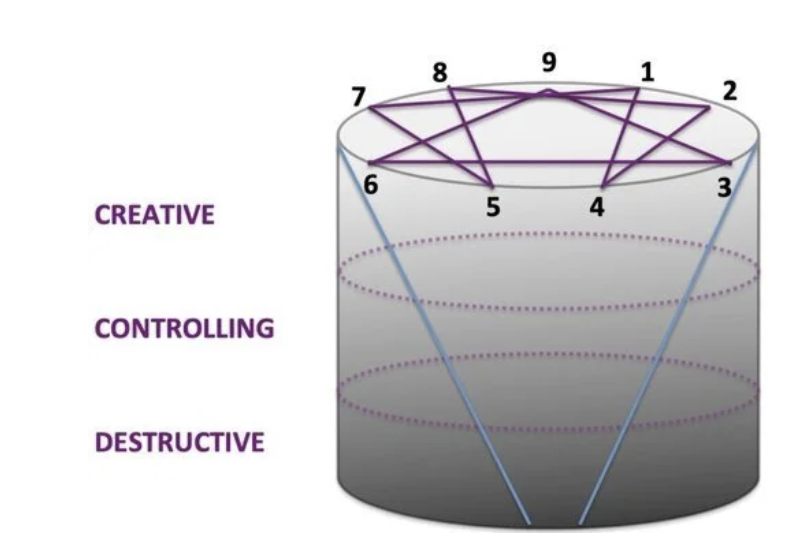
Chief Characteristics of Type 2 at different Levels of Consciousness
Creative: unconditional, nurturing
Controlling: flattering, hovering
Destructive: smothering, stalking
Shock Point Fear (the fear that causes the slip from Creative to Controlling Consciousness)
Whatever I have been doing for others is not enough to win their love.
Examples of what triggers the Shock Point Fear
My child doesn’t want to spend quality time with me.
The person I just met doesn’t invite me over to connect more closely as friends.
My colleague doesn’t start sharing secrets with me, even when I open up.
I wished more people a happy birthday than wished me one.
Why I get provoked Making me feel like we’re not as close as I feel, like I’m not selfless and caring enough to help you in all respects, like there are better friends and more loving people to have by your side, or bringing me in touch with my own deep-seated neediness, directly or indirectly.
How I cope with shame I become The Intimacy Igniter. I dive head-first into best-friend mode to make you see I’m the most loving person on earth, serving your every possible need, acting super-affectionately, lavishing you with praise, and becoming a robust generator of quality-time opportunities.
My emotions are too big for you!
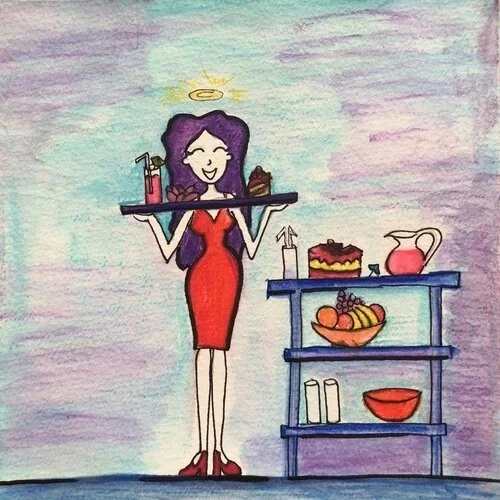
How was your day, Type 2?
“Oh, it was good, but how was YOUR day?”
The Wings
Type 2 with 1 Wing I’m bubbly and caring, with a grave side to me that is stringent on principles, sees things in black and white, and constantly expects more from myself than I can give, while I give so much.
Type 2 with 3 Wing I’m a rosy-cheeked storehouse of sweetness who is all about being with people. I love being everyone’s friend and confidante, but I secretly like to get claps for the things I do for people.
Directional Movements In growth, 2s become more self-aware, emotionally honest, and boundaried, like healthy 4s. In stress, 2s become more forceful, controlling, and demanding, like unhealthy 8s.
Personal Meditation for Growth My needs are human, and I can be honest about them with others.
Famous Type 2s
Loading…
Countries and Cultures that Reflect Type 2 Characteristics: The Image of the Italian, Jewish, and Indian Mother
The Type 2 across More Dimensions of the Enneagram (click on the + to reveal the full description)
-
1 in the Body Center
The Body Center is the seat of our instincts and our sense of autonomy. It’s where we react to life before we’ve had time to think, and where we guard our sense of how our world should work. 1s belong to the Body Center, and for them, the gut’s central question is one of rightness: Is this the way it should be?
Many 1s are surprised to find themselves here. They tend to see themselves as reasonable and principled, guided by careful thought rather than instinct. Their reactions feel like clear judgments about right and wrong, not gut responses! Yet the Body Center is home to anger, and 1s carry a great deal of it: at the mess, at the injustice, at the people who don’t seem to care.
Because anger doesn’t feel good or right, 1s hold it in. They tense up, keep themselves in check, and channel the heat into self-discipline, correction, and an Inner Critic that rarely rests. The anger doesn’t disappear. It leaks out as irritation and judgment, and when the pressure builds high enough, it comes out like a firehose, aimed with precision at whoever is in the way.
Growth for 1s means letting themselves feel their anger in the body instead of judging it in the mind…and discovering it was never proof that they are bad!
Learn more about this dimension of the Enneagram: The Centers of Intelligence.
-
1s and Frustration with the Protective Function
Parental Orientation helps us understand how each Type relates to love, safety, and connection. Rooted in object relations theory, it looks at a child’s earliest relationship with two essential parental functions. The Nurturing Function provides love, mirroring, and nourishment, helping the child feel seen and valued. The Protective Function provides discipline, support, and strength, helping the child feel safe and guided. Either parent can provide either function, and all of us continue to need both throughout our lives.
1s are frustrated with the Protective Function. Structure and moral clarity matter enormously to them, yet the guidance they received never felt good enough, precise enough, or principled enough. Picture a child who notices that the house rules change with a parent’s mood, and quietly decides: If no one is going to get this right, I will. 1s grow up taking the job over for themselves!
In adult life, it shows up as the voice that is always grading: the colleague who rewrites the procedure, the parent who can’t let a messy room slide, the volunteer who holds everyone to the mission. 1s become their own disciplinarian, judge, and corrector, and often everyone else’s too. Yet the frustration is never satisfied. No authority, institution, or person quite measures up, least of all themselves.
Growth doesn’t mean throwing out their standards! It means softening the inner judge. They have to let others guide and protect them without needing that protection to be perfect, so that structure becomes a support rather than a sentence. Then they can offer others the kind of guidance that helps people grow instead of making them feel bad.
Learn more about this dimension of the Enneagram: Parental Orientation.
-
1s in the Competency Harmonic
The Harmonics describe how each Type approaches conflict and tries to restore harmony. 1s belong to the Competency Harmonic, which looks to logic, structure, and agreements for resolving conflict: if we can agree on how this will work, we can move forward.
1s want to get it right. They come to a conflict convinced there is a correct way to resolve it, and usually that they already know what it is. They appeal to principles, rules, and fairness, and they hold everyone, themselves included, to the standard. Feelings that don’t fit the logic can seem like a distraction from the real issue. “It’s not personal, it’s the principle” becomes a favorite refrain.
At their best, 1s bring integrity and fairness to a conflict, naming what truly matters and helping everyone agree on a clear, principled way forward. But when competency is cut off from the heart, the plan turns into a verdict, and resolving a conflict becomes one more chance to be proven right.
Growth for 1s means remembering that being right isn’t the same as being in relationship, and bringing the other two Harmonics alongside their own: affirming the relationship with a Positive Outlook and having Emotional Realness about what each person is going through, so the solution serves the people involved and not just the principle.
Learn more about this dimension of the Enneagram: The Harmonics.
-
The Passion of the 1: Resentment
The Virtue of the 1: SerenityEach Type has a Passion and a Virtue. The Passion is the core emotional obsession that keeps the ego fortified as governor of the person. This trait is so pervasive that it usually goes unnoticed as the Type swims in it. Fittingly, passion comes from the Latin for suffering. The Virtue is its antidote – the quality that naturally emerges when the ego loosens its grip and the true self begins to come through more. For 1s, the Passion is Resentment and the Virtue is Serenity.
The Resentment of the 1 is not always obvious. Because anger doesn’t look good, 1s often work very very hard, mostly unbeknownst to them, at appearing calm, reasonable, and composed! But beneath the surface runs a quiet, constant tally of everything that isn’t as it should be: the dishes left in the sink, the colleague who cut corners, the world that won’t get its act together, and above all, their own failings. I’m the only one who seems to care, and even I can’t get it right.
This Resentment keeps 1s braced against life, holding everything up to the ideal and finding it lacking, far away from the goodness they long to feel in themselves and in the world.
Serenity is the way back. It begins with a question 1s rarely ask, or only ask on the surface: What if things don’t have to be perfect to be good? As they learn to accept what they cannot change, themselves included, they can still work for a better world, but no longer from a place of simmering disappointment.
Learn more about this dimension of the Enneagram: The Passions and Virtues.
-
“I Can’t Accept My Own Impurity.”
The Achilles Heel, a dimension of the Enneagram developed in our early days at Upbuild, names the one thing each Type cannot accept about itself that becomes its undoing. Like the mythical warrior who was invulnerable everywhere but his heel, we can think we’re strong in so many ways and still be brought down by what we refuse to see. For 1s, the Achilles Heel is: I can’t accept my own impurity.
1s want to be good, right, and pure. They aren’t any less pure than anyone else, but their impurity feels especially threatening, as if one mistake could prove they were bad all along. So they suppress, correct, judge, and control, scrubbing away at every flaw they find in themselves and everyone else. The more they reject their impurity, the more rigid and self-critical they become.
Acceptance rarely comes all at once. Much like grief, it tends to begin with denial and anger. A 1 is likely to first insist that their standards are simply correct, and then bristle at the suggestion that their criticism might be part of the problem.
Growth for 1s means grieving the perfect self they’ve been trying to become and turning toward the human being they actually are. Making peace with their own imperfections brings them into the striking recognition that imperfection was part of the path toward true goodness all along.
Learn more about this dimension of the Enneagram: The Achilles Heel.
-
Falling in Love with the 1
Our teacher Russ Hudson made a pact never to teach a Type he hadn’t fallen in love with. Inspired by him, we’ve made the same commitment, and this section is where we share it.
Falling in love with a Type means appreciating its gifts, feeling for its suffering, and finding an access point: a place in our own experience that lets us relate to what it’s like to be that Type.
When their hearts are truly at peace, 1s have a remarkable ability to see what is good and right, and to quietly live it, even when no one is watching. A very healthy 1 is wise, patient, and fair, holding high ideals while accepting people as they are. They notice what others overlook and care for it with devotion, and the sincerity of their striving can be beautiful.
Yet the goodness they long to bring to the world is the one they struggle most to find in themselves. They see impurity everywhere, starting within, and try so hard to correct, improve, and clean things up, but the work is never finished. Even a day of doing everything right can be undone by one small mistake. They suffer because they care so much and can never fully live up to the standard they feel called to embody.
The access point is one we all share: the experience of being bothered when people don’t seem to care. We have all seen something neglected and wondered, Why doesn’t this matter to anyone else? For 1s, that feeling is a constant weight. Seen this way, the rigidity, criticism, or even self-righteousness that can put people off is simply a sincere heart aching for a world that is good.
Learn more about this dimension of the Enneagram: Falling in Love.
For a deeper dive into the Type 2, listen to these podcast episodes: Type 2 Foundations and Type 2 Across the Dimensions
Continue Exploring
Learn to tell the Types apart with the 36 Type Misidentifications.
Explore the Enneagram in a more nuanced format through The Upbuild Enneagram Library podcast. Apple, Spotify, or wherever you get your podcasts.
If you’re looking for community and live conversation, join Upbuild Enneagram Library Live, a gathering held every other Thursday.
You can also join us for our two-day Enneagram 101 workshop, or reach out to learn more about a private Enneagram coaching session.