
PARENTAL ORIENTATION OF EVERY ENNEAGRAM TYPE
For a deeper dive on this dimension, listen to our podcast episode on the Parental Orientation
Parental Orientation is a dimension of the Enneagram that helps us understand how each Type relates to love, safety, and connection.
It is rooted in Object Relations Theory, which examines the child’s earliest relationship with two essential parental functions: the Nurturing Function and the Protective Function. These are functions rather than fixed parental roles. A mother may provide more of the protective function, while a father may provide more of the nurturing function.
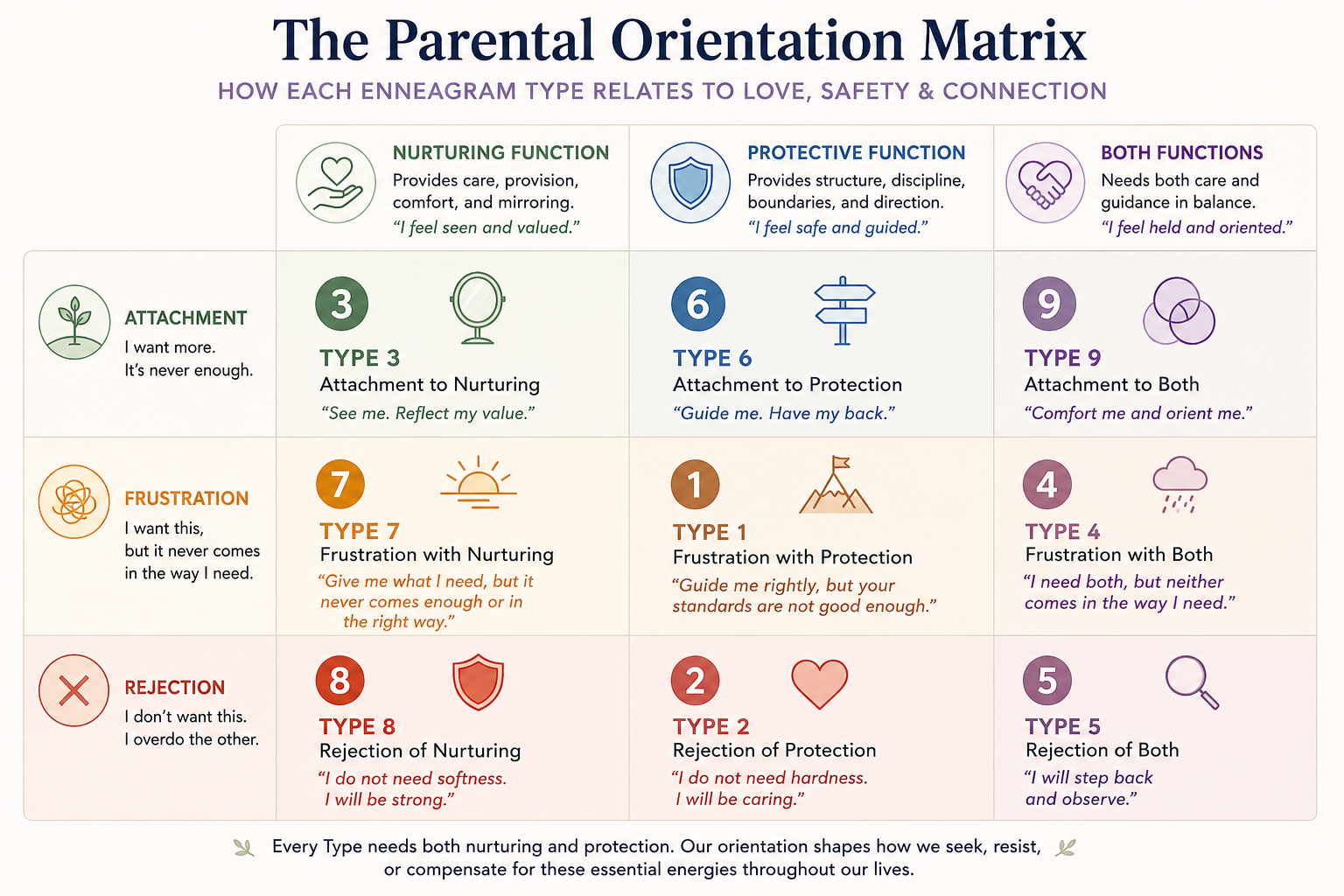
The Nurturing Function provides care, provision, comfort, and mirroring. It helps the child feel seen, loved, and valued.
The Protective Function provides structure, discipline, boundaries, and direction. It helps the child feel safe, guided, and oriented in the world.
Every child needs both functions, and every adult continues to need both. Each Enneagram Type, however, develops a particular orientation toward the Nurturing Function, the Protective Function, or both. This orientation becomes one of the unconscious patterns through which we seek love, security, and connection throughout our lives.
Importantly, this does not mean that our parents caused our Type. Rather, it describes the way our Type naturally comes into relationship with these two fundamental forms of care.
Understanding our Parental Orientation helps explain why certain relationship patterns feel so familiar, why particular needs seem so compelling, and why we often repeat the same dynamics long into adulthood.
The Three Relationships: Attachment, Frustration, and Rejection
Each Type relates to the parental functions through one of three patterns: Attachment, Frustration, or Rejection.
Attachment says, “I want more.” There is a hunger for the function, and it never feels like enough.
Frustration says, “I want this, but it is not coming in the way I need.” There is still attachment, but with disappointment, irritation, and the feeling that I have to do it myself.
Rejection says, “I do not want this.” The Type rejects one function and often overdevelops the other as compensation.
These three relationships combine with the three possible objects of focus: the Nurturing Function, the Protective Function, and both. Together, they create the nine Parental Orientations of the Enneagram as follows:
Type 1: Frustration with the Protective Function
Discipline, guidance, standards, and correction feel deeply important to Type 1s. But the protection they receive rarely feels good enough, precise enough, or principled enough. As a result, they often take over the Protective Function for themselves.
They become their own disciplinarian, judge, and corrector.
This helps explain why Type 1s can feel so responsible for knowing what is right and wrong. They are trying to provide the structure and moral clarity they feel has not been sufficiently provided.
The work for Type 1 is to soften the inner judge and receive protection without needing it to be perfect.
Type 2: Rejection of the Protective Function
Boundaries, discipline, firmness, and direction can feel too hard, too cold, or too withholding. As a result, Type 2s often overidentify with the Nurturing Function. They become caring, warm, helpful, and emotionally available.
But because they reject protection, Type 2s may struggle with boundaries, directness, and saying no. They can give care while neglecting the structure that would make love healthier.
The work for Type 2 is to recognize that protection is also love.
Type 3: Attachment to the Nurturing Function
Being seen, reflected, valued, and celebrated becomes deeply important to Type 3s, especially through the mirroring aspect of the Nurturing Function.
Like a child taking their first steps and seeing delight in a parent’s eyes, Type 3s continue looking for that same twinkle of recognition throughout life.
This can show up through achievement, success, titles, praise, performance, influence, or financial reward. The deeper longing is to feel mirrored back as valuable.
The work for Type 3 is to receive love without having to perform for it.
Type 4: Frustration with Both Functions
Neither nurturing nor protection seems to arrive in the way Type 4s need. They long deeply for both, but experience both as somehow missing, incomplete, or disappointing.
This can create a sense of deprivation, longing, and uniqueness around their suffering. Type 4s may feel that no one has truly provided what they needed, so they must somehow provide everything for themselves.
This reinforces the sense of being different, misunderstood, or left out of what others seem to receive naturally.
The work for Type 4 is to receive what is available without rejecting it because it is imperfect.
Type 5: Rejection of Both Functions
Both the Nurturing Function and the Protective Function can feel overwhelming, intrusive, confusing, or unreliable to Type 5s.
If nurturing feels too emotional and protection feels too demanding, the safer place becomes the mind. Type 5s often retreat into observation, objectivity, and knowledge.
This helps explain why they can feel like outsiders looking at life from a distance, preferring to understand rather than participate.
The work for Type 5 is to re-enter relationship with both care and guidance, without experiencing them as threats to autonomy.
Type 6: Attachment to the Protective Function
Guidance, support, direction, and the feeling that someone has their back become central for Type 6s.
The image is of a child being tossed into the air and caught again. Beneath much of the Type 6 personality is the question: Will someone catch me?
This orientation often shows up as a search for trustworthy authority, reliable systems, clear direction, and solid ground. When protection is absent or unreliable, Type 6s can become anxious, suspicious, or distrustful.
The work for Type 6 is to internalize protection, learning to trust both wise guidance and their own inner knowing.
Type 7: Frustration with the Nurturing Function
Feeling provided for, cared for, delighted, and free from deprivation becomes deeply important to Type 7s.
But the nurturing they receive often does not feel abundant enough, exciting enough, or satisfying enough. So they go out and create their own nourishment through experiences, options, plans, and pleasures.
This helps explain the Type 7 drive toward stimulation and possibility. They are trying to make sure they are never deprived.
The work for Type 7 is to receive ordinary nourishment without needing it to become extraordinary.
Type 8: Rejection of the Nurturing Function
Softness, tenderness, emotional need, and dependency can feel uncomfortable or even threatening to Type 8s.
As a result, they often overdevelop the Protective Function, becoming strong, decisive, forceful, and ready to defend themselves and others.
But rejecting nurturing can also cut them off from tenderness, receptivity, and the ability to be cared for.
The work for Type 8 is to recognize that nurturing is not weakness.
Type 9: Attachment to Both Functions
Comfort, mirroring, support, orientation, harmony, and steadiness all become deeply important to Type 9s.
They want both the Nurturing Function and the Protective Function to be present together, creating a sense of balance and peace.
But because they are attached to both, Type 9s can struggle to separate from others, assert themselves, or tolerate the tension that comes with real relationship.
The work for Type 9 is to receive both nurturing and protection while still showing up as a separate, important self.
Summing Up This Dimension
Parental Orientation helps us understand why certain relational patterns feel so old, so automatic, and so hard to change.
These patterns do not only show up with our parents. They show up with partners, friends, teachers, bosses, communities, spiritual authorities, and even our own children. We keep looking for, resisting, recreating, or compensating for the same functions.
When we understand our Parental Orientation, we begin to see what we have been trying to get, avoid, or do for ourselves.
The purpose of this dimension is not to blame our parents or reduce our personality to childhood experiences. The purpose is to see the pattern clearly enough that we can begin to heal.
Healing starts by recognizing what we needed, how we related to that need, and how that pattern is still operating in us now.
For some Types, the work is to acknowledge attachment without being ruled by it.
For some Types, the work is to acknowledge frustration without becoming bitter or self-sufficient in a hardened way.
For some Types, the work is to acknowledge rejection without continuing to cut off an essential part of love.
Every Type needs both nurturing and protection. Every Type also needs to learn how to offer both to others.
The Enneagram is not only a psychological tool. It is a spiritual tool. It helps us see the patterns of ego that keep us from living from the true self.
Our Parental Orientation shows us one of the earliest and most persistent ways the ego organizes itself. It shows us where we are still looking for something, defending against something, or trying to provide something for ourselves because we do not trust that it will be given.
As we become more conscious of this pattern, we can relate to our needs with more honesty and less entitlement. We can grieve what was missing without becoming defined by it. We can forgive without pretending that nothing happened. And we can become more capable of giving and receiving love in both of its essential forms: nurturing and protection.
The work of Parental Orientation is the work of growing up by finally understanding what that child has been looking for all along.
**We owe a particular debt of gratitude to our teachers at the Enneagram Institute, Don Riso and Russ Hudson, for their work with the Parental Orientation dimension of the Enneagram.
Explore the other dimensions of the Enneagram
Learn the Enneagram in a more nuanced format through The Upbuild Enneagram Library podcast. New episodes are added regularly. Listen on Apple, Spotify, or wherever you get your podcasts.
If you’re looking for community and live conversation, join Upbuild Enneagram Library LIVE, a bi-weekly gathering held on alternating Thursdays at 6:15pm ET.
You can also join us for our two-day Enneagram 101 workshop, or reach out to learn more about out a private Enneagram coaching session.