
ENNEAGRAM TYPE 9: THE PEACE-SEEKER
Type 9 Overview
9s long for harmony, both within themselves and with the people around them, and they feel anything that disturbs it intensely. They tend to see every side of a situation, smooth over tension, and seek out the routines, comforts, and relationships that help them feel at home. This often makes them calming, kind, and accepting presences, but it can also lead them to tune out problems, lose touch with their own priorities, and quietly disappear into the background.
Their drive to stay at peace can show up in every area of life: going along with others’ plans rather than voicing their own preferences, settling into familiar routines and comforts, putting off decisions that feel overwhelming, or reassuring everyone that things are fine when they aren’t. Their attention is continually drawn toward whatever might disturb their sense of calm, often creating an internal pressure to keep things smooth, avoid making waves, and stay comfortable.
When they feel secure, they become engaged and energized, recognizing that they matter and finding their voice, bringing people together while staying present to conflict and complexity. When they feel threatened, they become disengaged, stubborn, and prone to procrastination, retreating into their comfortable inner world and minimizing problems, until their suppressed anger suddenly bursts out like steam from a teakettle. Beneath their calm is a fear of losing their world of internal peace. Their growth involves becoming aware of how they retreat into their shell, and facing the anger and conflict they would rather avoid.
Behavioral Pattern Withdrawn. I need to be left alone in my own comfort zone, because there’s too much chaos and conflict in the world out there, which forever disturbs my peace.
Essence Qualities Wholeness, Unity, Flow
Basic Fear Losing my world of internal peace
Basic Desire To feel harmonious
Chief Characteristics of Type 9 at different Levels of Consciousness
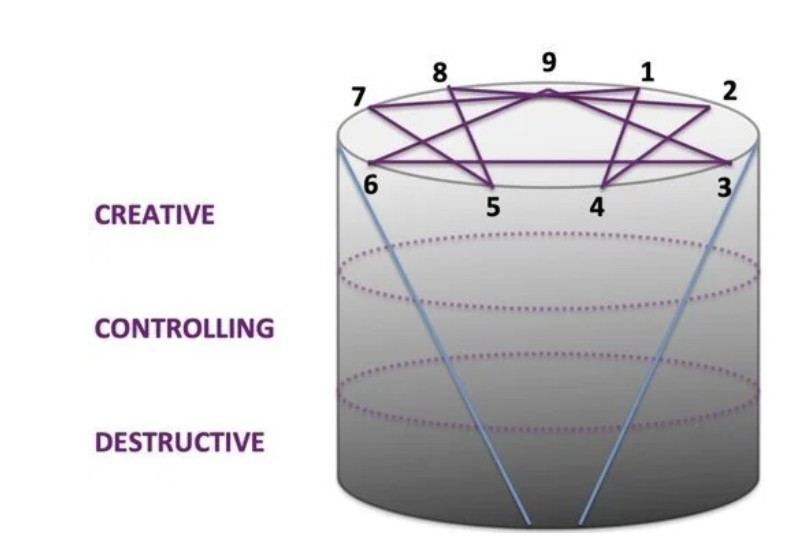
Creative: easygoing, synthesizing
Controlling: disengaged, procrastinating
Destructive: passive-aggressive, listless
Shock Point Fear (the fear that causes the slip from Creative to Controlling Consciousness)
I may not have the inner stability to deal with conflicts, internally and externally.
Examples of what triggers the Shock Point Fear
My wife wants to “talk” again… I don’t know how to do that. Everything’s fine enough, isn’t it?
I know I’m not totally fulfilled in my career, but why fix something that ain’t broke? It just keeps gnawing at me that this is not what I want to be doing in life, but I tell that gnawing to go away and be peaceful.
I have a deadline at work that’s creeping up on me. Yeah, I don’t fully believe in deadlines. They’re helpful sometimes, but I can also be all right without them… Things will get done when they get done; the key is to smile at people when they want something that’s overdue.
My roommate moved the place where we store the soap to create more space, and that completely threw me off. So what if I could find it easily (and they left a note just in case)? I really lost my balance with that move. Uncalled for.
I read the newspaper
Why I get provoked Disrupting my peace of mind by creating expectations, asking me to step out of my comfort zone, interfering with my routines, or inviting me to deal with the things I don’t want to deal with.
How I cope with anger I become The Teakettle. I rise and rise and rise and rise in temperature, but you can’t really tell that I’m getting hotter until little bubbles of moodiness, and then bigger bubbles of passive-aggressiveness, start to show, before I finally burst, when my anger comes out and morphs into a Grenade or a Firehose, depending on my wing.
My emotions are okay. I just keep them on a very low flame so I can be peaceful.
How was your day, Type 9?
“Fine.”
The Wings
Type 9 with 8 Wing I’m cool and casual, with an intensity that I keep guarded as I continue to be seen as the shy one in the room. Deep down, I hate weakness, I’m ever so subtly attracted to conflict, and I know how to make waves when I need to, though I still walk out of every situation as the calm, quiet one.
Type 9 with 1 Wing I’m sensitive, kind, and deeply concerned with ethics, constantly thinking about the ideal way to live, though I prefer to philosophize about it rather than truly live it, because that would require me to give up my homey, comfortable habits and step out into the world of conflict to make it better.
Directional Movements In growth, 9s become more focused, motivated, and action-oriented, like healthy 3s. In stress, 9s become more anxious, reactive, and defensive, like unhealthy 6s.
Personal Meditation for Growth I have the courage within me to deal with overwhelming problems in life.
Famous Type 9s
Loading…
Countries and Cultures that Reflect Type 9 Characteristics: India
The Type 9 across More Dimensions of the Enneagram (click on the + to reveal the full description)
-
9 in the Body Center
The Body Center is the seat of our instincts and our sense of autonomy. It’s where we react to life before we’ve had time to think, and where we guard our sense of how our world should work. 9s belong to the Body Center, and for them, the gut’s central question is one of peace: Can I keep my world undisturbed?
Many 9s are surprised to find themselves here. They see themselves as easygoing and calm, the last person anyone would call angry! Yet the Body Center is about being grounded in our own presence, and 9s are the Type most likely to lose touch with theirs. They merge with the people around them, settle into comfortable routines, and go along with whatever keeps things smooth, often without noticing they’ve left themselves out.
The Body Center is also home to anger, and 9s are the most out of touch with theirs. Anger would disturb the peace, so they push it down and numb it out. It doesn’t go away, though. It shows up as stubbornness, foot-dragging, and quiet resistance, and every so often it rises like steam in a teakettle until it bursts out, surprising everyone, the 9 included.
Growth for 9s means waking up to their own presence in the body…and discovering that their anger was a sign that they matter!
Learn more about this dimension of the Enneagram: The Centers of Intelligence.
-
9s and Attachment to Both Functions
Parental Orientation helps us understand how each Type relates to love, safety, and connection. Rooted in object relations theory, it looks at a child’s earliest relationship with two essential parental functions. The Nurturing Function provides love, mirroring, and nourishment, helping the child feel seen and valued. The Protective Function provides discipline, support, and strength, helping the child feel safe and guided. Either parent can provide either function, and all of us continue to need both throughout our lives.
9s are attached to both the Nurturing and the Protective Functions. They want the comfort of being loved and the steadiness of being guided, and above all they want the two to live in harmony. Picture a child in a home with tension in the air, who learns to keep everyone calm by being easy, agreeable, and no trouble at all. Something in them decides: If I don’t ask for much, everyone can stay together. 9s grow up becoming the peacekeeper!
In adult life, it shows up as the friend who goes along with everyone’s plans, the colleague who sees every side of an issue but rarely takes one, the partner who merges so fully with the relationship that their own wishes fade from view. Standing apart can feel like it might break the connection, so 9s struggle to separate from others or assert themselves. Yet attachment is never satisfied. The more they blend in, the less they feel truly met, by others or by themselves.
Growth doesn’t mean giving up their gift for harmony! It means showing up as a separate self. They have to let others love and guide them while still holding on to their own opinions, wants, and direction, so that the connection includes them too. Then they can offer others a kind of peace with a real person at its center.
Learn more about this dimension of the Enneagram: Parental Orientation.
-
9s in the Positive Outlook Harmonic
The Harmonics describe how each Type approaches conflict and tries to restore harmony. 9s belong to the Positive Outlook Harmonic, which looks to the good in each other and in the relationship for resolving conflict: if we focus on what’s good between us, everything will work out.
9s want the conflict to disappear, ideally before anyone has to talk about it. They downplay the problem, take in the other person’s point of view so fully that they lose track of their own, and reassure everyone that it’s really not a big deal. Underneath the calm is a simple wish: Can we please just get along? “It’s fine, really” becomes their way of keeping the peace.
At their best, 9s bring patience and empathy to a conflict, helping each side feel heard and reminding everyone of the common ground they share. But when positivity is used to avoid being disturbed, the real issues get minimized, and resolving a conflict becomes one more thing to wait out.
Growth for 9s means staying present when tension rises and saying what they actually think, and bringing the other two Harmonics alongside their own: having Emotional Realness about what each person is going through and using Competency to agree on a clear way forward, so the peace they find is real and not just quiet.
Learn more about this dimension of the Enneagram: The Harmonics.
-
The Passion of the 9: Sloth
The Virtue of the 9: EngagementEach Type has a Passion and a Virtue. The Passion is the core emotional obsession that keeps the ego fortified as governor of the person. This trait is so pervasive that it usually goes unnoticed as the Type swims in it. Fittingly, passion comes from the Latin for suffering. The Virtue is its antidote – the quality that naturally emerges when the ego loosens its grip and the true self begins to come through more. For 9s, the Passion is Sloth and the Virtue is Engagement.
The Sloth of the 9 is not always obvious. Many 9s are busy and productive, always doing something for someone! Their Sloth isn’t laziness so much as a reluctance to wake up to their own lives. Beneath the surface runs an unspoken assumption: If I don’t get too invested, nothing can disturb me. So they stay occupied with small, comfortable tasks while the things that truly matter to them get put off for another day.
This Sloth keeps 9s asleep to themselves, far away from the full presence they long to bring to life.
Engagement is the way back. It begins with a question 9s rarely ask, or only ask on the surface: What do I actually want? As they show up fully, with their own priorities, voice, and energy, they can still be peaceful and easygoing, but no longer at the cost of disappearing.
Learn more about this dimension of the Enneagram: The Passions and Virtues.
-
“I Can’t Accept My Own Importance.”
The Achilles Heel, a dimension of the Enneagram developed in our early days at Upbuild, names the one thing each Type cannot accept about itself that becomes its undoing. Like the mythical warrior who was invulnerable everywhere but his heel, we can think we’re strong in so many ways and still be brought down by what we refuse to see. For 9s, the Achilles Heel is: I can’t accept my own importance.
9s want to be peaceful, harmonious, and undisturbed. But if they matter, then their choices matter, their presence matters, and their voice matters, and that can feel like far too much pressure. So they make themselves smaller, defer to others, and hold back from full participation in their own lives. The more they deny their importance, the further they fade into the background, and the less peace they actually find.
Acceptance rarely comes all at once. Much like grief, it tends to begin with denial and anger. A 9 is likely to first insist that they’re just easygoing, and then bristle at the suggestion that they might be hiding from their own life.
Growth for 9s means grieving the years spent in the background and turning toward the person who has been there all along. As they let themselves take up space, they come to see that the peace they were looking for comes from showing up, not from disappearing.
Learn more about this dimension of the Enneagram: The Achilles Heel.
-
Falling in Love with the 9
Our teacher Russ Hudson made a pact never to teach a Type he hadn’t fallen in love with. Inspired by him, we’ve made the same commitment, and this section is where we share it.
Falling in love with a Type means appreciating its gifts, feeling for its suffering, and finding an access point: a place in our own experience that lets us relate to what it’s like to be that Type.
When their hearts are truly open, 9s carry an unassuming kindness that makes everyone feel welcome. They can hold many perspectives at once, make room for others, and sense how broken the world is without wanting to add more conflict to it. A very healthy 9 doesn’t need to dominate the room. People feel safe around them simply because they don’t make themselves the center, and their patience and steadiness can heal divisions others thought were permanent.
Yet the peace they bring to others is the one they struggle most to keep for themselves. Conflict, pain, and separation register so deeply that the brokenness of the world can feel overwhelming. To avoid feeling it, 9s may hide, numb out, procrastinate, or tell themselves they don’t matter enough to make a difference. Their humility can turn into self-erasure, and their desire for peace into avoidance.
The access point is one we all share: the wish to disappear when conflict feels like too much. We all know what it’s like to retreat into comfort rather than deal with what is broken. For 9s, that retreat can become a way of life. Seen this way, the stubbornness, passivity, or even stonewalling that can put people off is simply a gentle heart trying to keep the world whole.
Learn more about this dimension of the Enneagram: Falling in Love.
For a deeper dive into the Type 9, listen to these podcast episodes: Type 9 Foundations and Type 9 Across the Dimensions
Continue Exploring
Learn to tell the Types apart with the 36 Type Misidentifications.
Explore the Enneagram in a more nuanced format through The Upbuild Enneagram Library podcast. Apple, Spotify, or wherever you get your podcasts.
If you’re looking for community and live conversation, join Upbuild Enneagram Library Live, a gathering held every other Thursday.
You can also join us for our two-day Enneagram 101 workshop, or reach out to learn more about a private Enneagram coaching session.