
Walt Disney: Enneagram 3w4
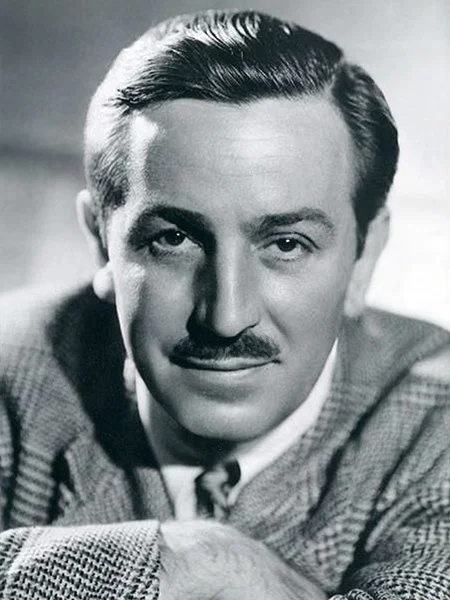
Boy Scouts of America, Public domain, via Wikimedia Commons
Why Walt Disney is a Type 3
Ambitious from the beginning. Disney liked attention and success from an early age. After selling some of his first cartoons to a Kansas City theater, he remembered, “I got to be a little celebrity.” At 20, he left a steady job and made himself president of Laugh-O-Grams. The company failed, leaving him unable to pay his employees or even his rent, but he remained convinced that his ideas would eventually work. He headed to Hollywood and started again.
More determined after losing Oswald. Disney’s distributor owned the rights to Oswald the Lucky Rabbit and quietly recruited most of his animators away from him. Disney was devastated, but his response was competitive. He began working with Ub Iwerks on a character they would own, and Mickey Mouse emerged. When the first Mickey cartoons failed to attract a distributor, Disney added synchronized sound and turned Steamboat Willie into a sensation. Years later, he described his talking animals as a way to “crowd our way into the competition.”
Putting his own name on the studio. In 1926, Disney changed the name of the Disney Brothers Studio to the Walt Disney Studio. He believed that his vision was what the company was selling, and he wanted the name to reflect that. Roy handled the finances, Iwerks was the stronger draftsman, and hundreds of artists eventually brought the films to life. Walt’s particular talent was finding those people, drawing out their best work, and deciding what the finished product should be. He became the first animation producer the public knew by name, and everything the studio made became associated with him personally.
Warm and comfortable in front of a camera. Disney was relaxed in interviews and knew how to tell his story in a smooth, relatable way. On television, he became “Uncle Walt,” the friendly host who seemed to be speaking directly to each family in its living room. He enjoyed the role, often abandoned the prepared script, and was comfortable improvising. But he also understood that the public Walt Disney was partly a character. “I’m not Walt Disney,” he once told a friend, distinguishing the private man from the wholesome figure people thought they knew.
Knowing what the audience would pay for. When an interviewer asked whether Disney films were mainly made for children, he replied, “You have to appeal to the adults because they have all the money.”
Very good at selling a dream. Disney’s salesmanship worked because he seemed completely convinced by what he was selling. When he needed money for Disneyland, he offered ABC a weekly television series built around the park’s different lands. ABC contributed $500,000 toward construction and guaranteed additional loans. The program then allowed Disney to introduce the unfinished park to millions of families before it opened. He turned the financing, promotion, and entertainment into one project.
Always looking for the next breakthrough. Disney repeatedly looked for whatever could put his studio ahead of the competition. Synchronized sound helped make Mickey famous. When three-strip Technicolor became available, he ordered Flowers and Trees converted from black-and-white even though production was already underway. He then secured a two-year exclusive agreement that gave Disney a head start over other animation studios. After sound and color came feature films, television, theme parks, Audio-Animatronics, and new combinations of live action and animation. Each success quickly became the starting point for the next experiment.
Friendly, informal, and very demanding. Disney insisted that employees call him Walt. He played volleyball with them, brought artists and professors into the studio to teach classes, and created an atmosphere in which talented people could experiment. He could be funny, enthusiastic, and inspiring. He could also be intimidating. He demanded long hours, high productivity, and the final word on every finished film.
Trying to build the city of the future. Near the end of his life, Disney’s ambition had moved beyond entertainment. EPCOT was originally imagined as an Experimental Prototype Community of Tomorrow, not another theme park. He studied urban design and became preoccupied with traffic, education, waste collection, and the decline of American cities. According to his colleague Marty Sklar, Disney kept returning to the idea of meeting people’s needs. After cartoons, films, television, and Disneyland, he wanted to build a working city that could serve as a model for the future. He died before it could be attempted in the form he envisioned, still trying to make the next dream larger than the last.
Continue Exploring
Type 3 Profiles (with evidence): Taylor Swift, Tiger Woods, Elon Musk, Madonna, Serena Williams, Barack Obama
Understand Type 3: Type 3 The Achiever
Common Type 3 Mistypes (and how to tell the difference): Type 3 vs Type 7, Type 3 vs Type 9
All Famous Person Types: Hundreds of profiles (with evidence)
Enneagram Community (live teaching and discussion twice monthly): Enneagram Library Live