
Steve Jobs: Enneagram 3w4
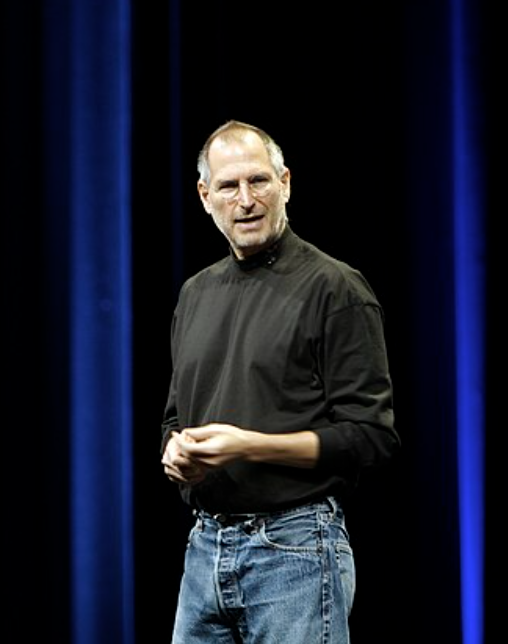
TechCrunch, CC BY 2.0, via Wikimedia Commons
Why Steve Jobs is a Type 3
Early fixation on being exceptional. Biographies describe Jobs as unusually intense and self-assured even as a teenager. Classmates at Homestead High School recalled that he carried himself with a confidence and intensity that set him apart from many of his peers. While still in high school, he cold-called Bill Hewlett to ask for spare parts for a frequency counter he was building, which led to a summer job at Hewlett-Packard.
Reframing personal identity around visible achievement at Apple’s founding. When Apple was founded in 1976, Jobs was not the strongest engineer in the room, but he immediately positioned himself as the visionary face of the company. Colleagues noted that he focused intensely on how the product, and Apple itself, would be perceived publicly, from packaging to launch narratives.
Relentless image control in public presentations. Jobs rehearsed product launches obsessively, often scripting them down to the exact phrasing and timing. Former Apple employees described him practicing keynote transitions for hours, treating each event as a performance meant to define how he would be remembered. The goal was not merely to inform, but to deliver a defining moment of excellence.
Pursuit of visible “world-changing” milestones over incremental success. Jobs consistently framed Apple’s mission in grand, legacy-oriented terms. He wanted to make “a dent in the universe.” This framing shaped decisions such as prioritizing breakthrough products like the Macintosh over safer investments in existing machines. For Jobs, being associated with landmark achievements was central.
Intolerance for failure that did not fit the success narrative. At Apple, Jobs was known to publicly shame employees whose work he deemed substandard, sometimes in meetings. Former team members reported that mistakes were treated as threats to excellence. This went beyond normal high standards. The environment rewarded those who upheld the image of brilliance and quickly marginalized those who did not.
Careful curation of the “visionary minimalist” persona. Jobs’ black turtleneck, jeans, and sneakers became a deliberate uniform by the late 90s. Biographers note that this was inspired in part by his admiration for Sony executives and Zen aesthetics, but it also functioned as branding. The simplicity projected confidence and inevitability, architecting the uniquely recognizable and deliberately memorable image of a leader above ordinary concerns.
Redemption arc upon returning to Apple in 1997. When Jobs returned as interim CEO, he immediately tied his comeback to a dramatic turnaround narrative. He simplified Apple’s product line, staged bold marketing campaigns like “Think Different,” and placed himself back at the center of the story. Media coverage collaborated with his story by framing him as a fallen genius reclaiming his throne.
Stanford commencement speech about meaning that also framed life as a legacy project. In his 2005 Stanford address, Jobs structured his life story around turning points that led to meaningful success and impact. He emphasized being remembered for following passion and doing “great work.” The speech presented hardship mainly as fuel for eventual triumph. It functioned as both advice and a summation of how he understood his own life so others can succeed like him.
Final years focused on cementing a lasting contribution. In his last years as CEO, Jobs worked intensely on products like the iPhone and iPad, even as his health declined. Colleagues recalled him pushing himself physically to see these launches through. These were capstone achievements meant to, again, define his legacy. The urgency reflected a drive to finish strong and be remembered for his impact.
Steve Jobs quotes that show he is a Type 3
“We’re here to put a dent in the universe. Otherwise why else even be here?”
“I think if you do something and it turns out pretty good, then you should go do something else wonderful, not dwell on it for too long.”
“Being the richest man in the cemetery doesn’t matter to me…Going to bed at night saying we’ve done something wonderful… that’s what matters to me.”
“Innovation distinguishes between a leader and a follower.”
“My job is not to be easy on people. My job is to make them better.”
“One home run is much better than two doubles.”
“I’m as proud of what we don’t do as I am of what we do.”
“Your time is limited, so don’t waste it living someone else’s life.”
“Be a yardstick of quality. Some people aren’t used to an environment where excellence is expected.”
“People think focus means saying yes to the thing you’ve got to focus on… It means saying no to the hundred other good ideas.”
“We’re here to make the best products on earth, and if we can’t make the best, we won’t make it.”
Continue Exploring
Type 3 Profiles (With Evidence): Taylor Swift, Tiger Woods, Elon Musk, Madonna, Serena Williams, Barack Obama
Understand Type 3: Type 3 The Achiever
Common Type 3 Mistypes (and how to tell the difference): Type 3 vs Type 7, Type 3 vs Type 9
All Celebrity Types: Hundreds of Profiles (With Evidence)
Enneagram Community (live teaching and discussion twice monthly): Enneagram Library Live