
Russell Crowe: Enneagram 3w4
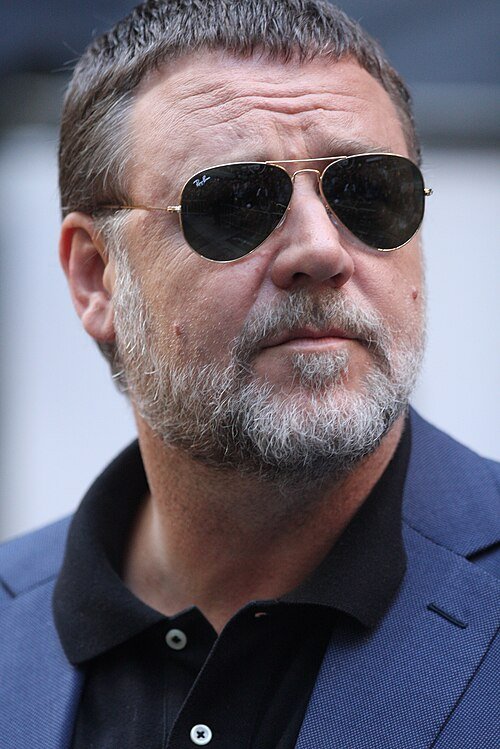
Eva Rinaldi from Sydney Australia, CC BY-SA 2.0, via Wikimedia Commons
Why Russell Crowe is a Type 3
Wanting stardom the way other people wanted coffee. At 19, Crowe was already performing under the name Russ le Roq, working as a nightclub DJ, writing songs, playing in bands, and appearing in Grease. A contemporary profile on Crowe declared that he wanted stardom the way most people wanted strong coffee. His records sold poorly, gigs paid almost nothing, and he spent far more on his music than he earned. He still talked about hit records, a fan club, and being stopped for autographs. “I might never make it,” he said, “but I’ll give it a helluva whack.”
Creating Russ le Roq before Russell Crowe was famous. The stage name came with professional photographs, carefully arranged hair, guitar poses, a fan-club address, and a debut single called “I Just Wanna Be Like Marlon Brando.” Crowe was not waiting to be discovered as an unformed natural talent. He had already pictured the kind of figure he intended to become and was assembling the image with whatever resources were available. Years later he could laugh at those early recordings as some of the worst in New Zealand music, but he never disowned the young performer’s appetite to be seen.
Laconic charm. In interviews, Crowe can appear as if he is playing with both the interviewer and the audience. He speaks slowly, lets a silence sit, then answers with a sideways joke or a line that is flirtatious. A Los Angeles Times profile caught his natural charisma emerging while he teased a woman who approached him in a restaurant. Another interviewer found him so charming and matey that a long wait for his arrival was quickly forgiven. The smoothness carries the suggestion that he knows the effect he is having and is pleased enough to let everyone else notice it too.
Using jokes and skepticism to control the mood. Crowe seems very aware that a television interview is a performance and that the questions and editing can shape how he comes across. In a 60 Minutes interview, he pushes back against the interviewer’s attempt to set the mood, then turns the whole thing playful. He often responds to compliments with a joke, a skeptical look, or a sudden shift in tone. It makes him hard to pin down and keeps him in control of the exchange
Keeping music as an identity that success could not replace. Crowe continued writing, recording, and touring after his acting career made him internationally famous. His bands changed names and configurations, but the music never disappeared. He has said that people will learn more about him from the subjects of his songs than from interviews. Onstage, he enjoys the anarchy of responding to a room and letting the audience alter the night. Acting made him admired; music lets him present himself as an author, frontman, and storyteller. He kept pursuing it even when critics treated the project as a movie star’s indulgence (this also speaks to his 4 Wing).
Turning loyalty to the Rabbitohs into a visible turnaround. Crowe’s attachment to the South Sydney Rabbitohs went beyond celebrity fandom. In 2006 he and Peter Holmes à Court won member approval to take a controlling interest in a struggling club. The organization was reworked, sponsors and prominent recruits arrived, and South Sydney reached the finals in 2007 for the first time in 18 years. In 2014 the club ended a forty-three-year premiership drought. Crowe brought money, contacts, persuasion, and an instinct for presentation to a team whose proud history had become associated with defeat. Restoring it gave him another arena in which identity and winning could reinforce each other.
Continue Exploring
Type 3 Profiles (With Evidence): Taylor Swift, Tiger Woods, Elon Musk, Madonna, Serena Williams, Barack Obama
Understand Type 3: Type 3 The Achiever
Common Type 3 Mistypes (and how to tell the difference): Type 3 vs Type 7, Type 3 vs Type 9
All Celebrity Types: Hundreds of Profiles (With Evidence)
Enneagram Community (live teaching and discussion twice monthly): Enneagram Library Live