
Ronald Reagan: Enneagram 3w2
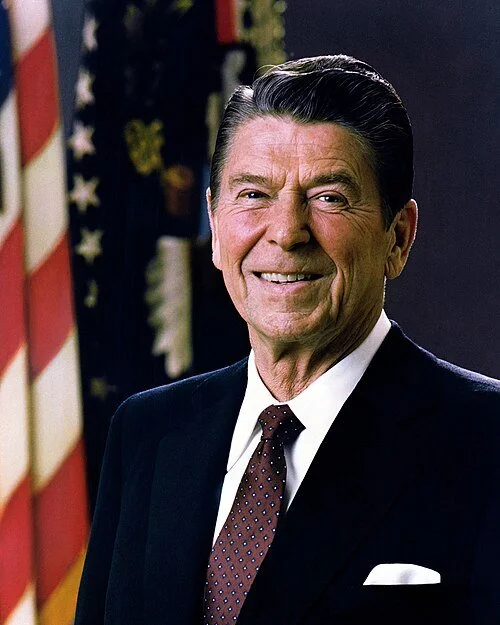
Michael Evans, Public domain, via Wikimedia Commons
Why Ronald Reagan is a Type 3
An early instinct for roles that made him visible and useful. Long before national politics, Reagan repeatedly moved toward positions in which he could be recognized as the reassuring person at the center. He was student-body president in both high school and college, participated in drama and athletics, helped lead a college strike, and spent seven summers as a lifeguard, where he was credited with seventy-seven rescues. Later he was repeatedly elected president of the Screen Actors Guild. Even the small detail that he was reportedly disappointed when he failed to become honorary mayor of Hollywood suggests that titles and public affirmation mattered to him. His ambition often came wrapped in usefulness, genial leadership, and a desire to be the person others naturally chose.
Making an unseen baseball game feel real. As a young radio announcer, Reagan recreated Chicago Cubs games in a Des Moines studio from terse telegraph reports. When the wire failed during a 1934 game, he did not freeze or confess that he had no information. He calmly invented a succession of foul balls for nearly twelve minutes until the connection returned. The episode shows his quick thinking and his comfort with creating a vivid reality from incomplete information. He trusted his voice enough to carry listeners with him. He retold the story for decades, turning an improvised save into a polished piece of personal mythology. The ability to make the audience see what he wanted them to see would become one of his defining political gifts.
Rehearsing until preparation disappeared. Reagan’s ease was carefully built. The speech that became “A Time for Choosing” had been delivered in evolving forms to many audiences; the Reagan Library describes every word as honed, measured, and memorized before the televised version. As president, he still relied on texts, teleprompters, and his famous three-by-five cards, editing material until it fit his own rhythm. Yet the finished delivery felt conversational rather than studied. James Baker remembered him as “so comfortable in his own skin,” even when working from prepared material. This was a central feature of Reagan’s polish: the labor remained backstage. What the audience received was warmth, certainty, and the impression that the words had simply occurred to him.
A natural salesman who gravitated toward sales in many different ways. Hosting General Electric Theater gave Reagan an unusually literal apprenticeship in salesmanship. He introduced dramas, appeared in commercials, and even brought Nancy and their daughter Patti into home-based demonstrations of GE appliances. As the company’s spokesman, he also toured plants around the country and spoke directly to employees. He learned how to make a corporate message feel personal: begin with a story or joke, establish shared values, and let the pitch emerge as common sense. During those tours, he gradually began selling something larger than appliances—the virtues of free enterprise and limited government. His later politics retained that amiable commercial texture.
Reinventing himself while preserving a coherent identity. Reagan began as a committed New Deal Democrat, supported Franklin Roosevelt, introduced Harry Truman at a campaign rally, and remained formally Democratic even while campaigning for Eisenhower and Nixon. By 1962 he had become a Republican and soon emerged as the most persuasive national voice of modern conservatism. He did not present the change as an ambitious man discovering a more promising market. He preserved the emotional continuity of his story. The parties had changed, while his faith in ordinary Americans had not.
A showman with an understanding of “the need for showmanship.” Reagan’s political career was effectively launched by a televised performance. His 1964 address for Barry Goldwater was so successful that supporters organized Friends of Ronald Reagan almost immediately; two years later, he won the California governorship in a landslide. He understood that politics rewarded the person who could embody a message convincingly enough that viewers wanted to follow him. Reagan once observed that politics involved “the need for showmanship.”
Humor as charm, reassurance, and a shield. With unfamiliar people, Reagan often substituted jokes for disclosure. Campaign strategist Stuart Spencer recalled that visitors could leave an encounter charmed but unsure what substantive subject had actually been discussed: “He just told jokes.” Humor let Reagan establish likability, control the emotional temperature, and remain personally elusive. It was also his reflex under frightening pressure. After being shot in 1981, he joked with Nancy that he had forgotten to duck and told the surgeons, “I hope you’re all Republicans.”
An ability to “charm the socks off of you.” Reagan’s charm was not confined to voters. Soon after taking office, he invited Democratic House Speaker Tip O’Neill and his wife to an intimate dinner. Reagan and O’Neill traded Irish jokes, Reagan toasted the Speaker’s career, and by the end of the night they were “Ron” and “Tip.” A congressional liaison said Reagan could “charm the socks off of you.” Their policy fights remained real and sometimes bitter, but Reagan resisted returning O’Neill’s personal attacks; he would wave them away with, “Oh, that’s just Tip.” The 2 Wing is especially visible here as his pursuit of results was strengthened by warmth, courtesy, praise, and an instinct for making another person feel liked.
Turning vulnerabilities into applause lines. Reagan had an instinct for the phrase that would change the mood of a room. When Jimmy Carter attacked his earlier position on Medicare in the 1980 debate, Reagan smiled and replied, “There you go again,” converting a substantive criticism into an image of Carter as nagging and repetitive. Four years later, after a poor first debate had intensified concern about his age, Reagan promised not to exploit Walter Mondale’s “youth and inexperience.” The audience erupted, and even Mondale laughed.
Selling optimism as a national product. Reagan’s central product was a feeling that America could be confident and admired again. His first inaugural compressed a complicated argument into the brandable line, “government is not the solution to our problem; government is the problem.” In 1984, “It’s morning again in America” surrounded him with weddings, new homes, flags, work, and soft light. The campaign’s advertising was explicitly designed to evoke emotion, and Reagan’s sunny persona made the promise believable. He made voters feel that choosing him was a way of choosing hope, and of joining the winning side of the national story.
Warmly responsive to strangers and difficult to reach at home. Reagan devoted time to citizen correspondence and on several occasions sent personal checks to people who wrote about financial hardship. Yet those closest to him often experienced an emotional distance. His children described him as mysterious, and Nancy said, “There’s a wall around him. He lets me come closer than anyone else, but there are times when even I feel that barrier.”
Continue Exploring
Type 3 Profiles (With Evidence): Taylor Swift, Tiger Woods, Elon Musk, Madonna, Serena Williams, Barack Obama
Understand Type 3: Type 3 The Achiever
Common Type 3 Mistypes (and how to tell the difference): Type 3 vs Type 7, Type 3 vs Type 9
All Celebrity Types: Hundreds of Profiles (With Evidence)
Enneagram Community (live teaching and discussion twice monthly): Enneagram Library Live