
Rahm Emanuel: Enneagram 3w4
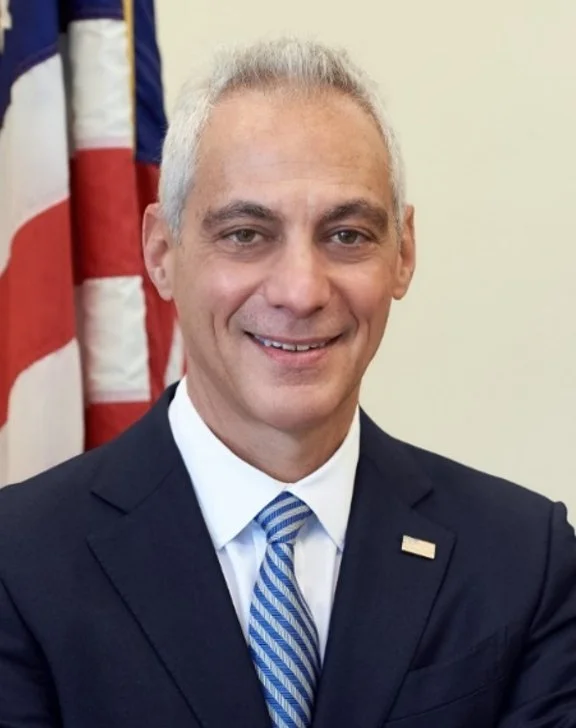
U.S. Embassy in Japan, Public domain, via Wikimedia Commons
Why Rahm Emanuel is a Type 3
Too much ego to be second string. His mother made all three Emanuel boys take ballet, but Rahm was the only one who stayed with it. He trained for six years, endured teasing, performed in high school, and received a scholarship to the Joffrey Ballet. He eventually decided he did not have the physical build for a major career. “I would always be second string, and I had too much ego for that,” he said.
Thriving in an environment where achievement was paramount. Emanuel’s parents displayed their sons’ report cards on the refrigerator, where anyone entering through the kitchen could see them. He described the family attitude as “failure is not an option.” His brothers also became unusually successful. Zeke went into medicine and bioethics, while Ari became one of Hollywood’s most powerful agents. The three were intensely competitive. Rahm thrived in an environment where his performance was noticed, measured, and compared.
Planning his way to the White House (and power). At 25, Emanuel was already thinking several moves ahead. He compressed a Northwestern master’s program into nine months while continuing to dance and work in Illinois politics. His goal was to finish school and “figure out how to one day work for a person who’s going to be elected president.” He later served Bill Clinton and Barack Obama. In Congress, he had another precise goal of becoming the first Jewish Speaker of the House. He described his committee positions and leadership campaigns as pieces of the puzzle he was assembling to get there.
Relentless on the phone. Emanuel first became nationally important as a fundraiser for Bill Clinton’s 1992 campaign. He could flatter, cajole, joke, and apply pressure in the same phone call. A reporter watched him warmly greet a donor while staring at the donor’s name and a $10,000 target written on a pad. Emanuel described his method as “Surround ’em in love, just love them to death!” The campaign raised a record amount, and the money allowed Clinton to survive the scandals that nearly ended his candidacy. Emanuel knew how to read people and get them invested in a winner.
“Winning is what I do.” When Emanuel took over the Democratic Congressional Campaign Committee, experts expected the party to gain only a few seats. He recruited candidates who could win in conservative districts, pushed them to raise more money, and removed weaker candidates from important races. Ideological purity mattered less to him than the final count. Democrats gained around 30 seats in 2006 and won control of the House. Emanuel had raised nearly $120 million and lost 14 pounds during the campaign from being obsessed with his work. Near the end, he was waking at three in the morning to study races and plan the next move. He has said, “Winning is what I do.”
Charming people and pushing them hard. Emanuel’s forcefulness is often mixed with personal attention. One colleague remembered watching him scream at a candidate and then send the candidate a cheesecake. When David Axelrod’s son was born, Emanuel tracked Axelrod down in the hospital recovery room, congratulated him, paused, and asked when he would be back at work. As a fundraiser, he could make donors feel courted even while pressing them for more money. People around him rarely have to wonder what he wants, but he usually understands what they need in order to give it to him.
A hard edge with affection. People who have worked for Emanuel also describe a protective side that receives less attention. After an aide was mugged at gunpoint, he required her to call him every night when she arrived home safely. Although he regularly contacted employees outside working hours, a former policy director said Emanuel would end a call if he heard the employee’s children in the background.
The person who gets it done. Emanuel gave up his planned path toward Speaker when Obama asked him to become White House chief of staff. He disliked sacrificing his own goal, but he also knew that the job would put him at the center of an economic crisis and a major legislative agenda. Obama later wrote that Emanuel’s “pile-driver style” was exactly what he needed. Emanuel helped push through the economic recovery package, the auto rescue, and the Affordable Care Act. He was less interested in being the calm voice in the room than in being the person who could count the votes, make the calls, and close the deal.
Knowing when to soften the act. When Emanuel ran for mayor of Chicago, the profanity and explosive behavior that had built his Washington reputation became less useful. He stopped swearing in public, stayed composed through a long dispute over whether he met the city’s residency requirements, and presented himself as a calm public servant eager to get to work. Asked about his language near the end of the campaign, he joked, “Have I done that in seven months?” His basic personality had not changed. He understood that a candidate meeting families at train stops and school auditoriums needed a different public style from a political operative working behind closed doors.
Running Chicago by the numbers. Emanuel approached the mayor’s office like a large turnaround job. He lengthened the school day, expanded full-day kindergarten and prekindergarten, reorganized the community-college system around employment, and made education the centerpiece of his record. High-school graduation rates rose considerably during his eight years in office. He spoke constantly about targets, measurements, and where Chicago ranked against other cities. Progress needed to be visible. Even in his exit interviews, he moved quickly through statistics on schools, employment, transportation, and poverty to show that the city was better prepared than when he arrived.
Reinventing himself as the “undiplomat” As ambassador to Japan, Emanuel again reshaped himself around a new role. He rode Tokyo’s trains, joined public events, used social media aggressively, and became far more visible than a conventional ambassador. “I come in color,” he said. “The goal is to put points on the board, get results.” He helped negotiate economic and security agreements while building a recognizable public identity as “Rahm-san” and the train-loving “undiplomat.” Even diplomacy became another active, measurable campaign rather than a quiet ceremonial posting.
Always looking for the next arena. Emanuel left Japan in 2025, but he did not settle into retirement. By June 2026, he was visiting union halls and house parties in New Hampshire while considering a presidential campaign. He cycled more than 100 miles across the state on what he called a “Spin-Free Tour,” testing a message built around toughness, the middle class, and government results. He has not formally announced a 2028 run, but there is little mystery about the ambition. Even after serving in two White Houses, Congress, Chicago, and Japan, he is still looking for the next difficult contest.
Continue Exploring
Type 3 Profiles (with evidence): Taylor Swift, Tiger Woods, Elon Musk, Madonna, Serena Williams, Barack Obama
Understand Type 3: Type 3 The Achiever
Common Type 3 Mistypes (and how to tell the difference): Type 3 vs Type 7, Type 3 vs Type 9
All Famous Person Types: Hundreds of profiles (with evidence)
Enneagram Community (live teaching and discussion twice monthly): Enneagram Library Live