
Joe Rogan: Enneagram 7w8
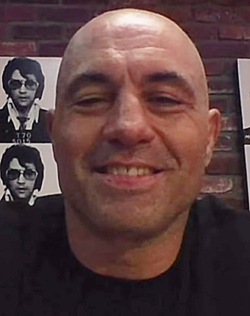
Steven Crowder CC BY 3.0 via Wikimedia Commons
Why Joe Rogan is a Type 7
Physically expressive presence oriented toward intensity and enjoyment. Whether commentating UFC fights or discussing training, Rogan’s body language is animated. He often leans forward, raises his voice, and shows visible excitement. His language highlights the thrill of the moment (“that’s insane,” “that’s wild”), foregrounding the excitement of the experience more than technical breakdown.
Long-form podcasting as an antidote to boredom. In 2009–2010, podcasting had little prestige or financial upside. Rogan has said repeatedly that the podcast began as a way to have fun conversations with friends rather than to build a media empire.
Pursuit of novelty across domains. Before achieving mainstream recognition as a podcaster, Rogan moved across an unusually wide range of pursuits: stand-up comedy, television acting (NewsRadio), martial arts competition and instruction, color commentary for the Ultimate Fighting Championship, and hosting the reality show Fear Factor. Rather than specializing narrowly, he repeatedly explored new arenas that captured his interest, often pursuing several at the same time.
Rapid-fire conversational style that prioritizes exploration over resolution. On The Joe Rogan Experience, Rogan frequently jumps topics mid-thought, following curiosity rather than argument closure. Episodes sprawl for 3–4 hours, with tangents encouraged rather than edited out. The result is discovery and excitement-oriented dialogue, optimized for possibility rather than conclusions.
Pattern of saying yes for the sake of adventure. Across interviews about his career decisions, Rogan has emphasized curiosity, enjoyment, and low expectations rather than structured planning. The consistent pattern is get involved first and figure out the rest later. He accepted Fear Factor as a short-term paycheck rather than a strategic brand move and has said he assumed the show would not last. His early podcasting similarly began as an informal experiment with friends, without monetization, a release strategy, or a defined ambition. He has also described entering UFC commentary through personal interest rather than career calculation.
Curiosity-driven guest selection that defies audience and commercial optimization. Rogan routinely invites guests who are commercially risky or polarizing – ranging from psychedelic researchers and hunters to monks, political dissidents, and controversial public figures. Several episodes sparked major backlash, including interviews with COVID-19 contrarian doctors such as Robert Malone and Peter McCullough in 2021–2022, which prompted open letters from medical professionals and protests from musicians like Neil Young and Joni Mitchell, who removed their music from Spotify in response. Despite the public pressure and advertiser concerns that followed, Rogan largely continued booking guests based on personal curiosity rather than reputational safety. He shows a lot of enthusiasm to explore unusual perspectives firsthand, even when doing so invites controversy.
A variety of training obsessions. Rogan has cycled intensely through martial arts (like Taekwondo and Brazilian jiu-jitsu), kettlebells, yoga, sauna protocols, and hunting. Each is pursued with zeal, then sometimes supplemented by the next fascination.
Persistent excitement about what’s next. Across decades of interviews, Rogan tends to pivot quickly toward new interests, guests, trips, or experiments he wants to explore. Instead of dwelling on past accomplishments, his attention moves toward the next stimulating possibility. The tone is less about achievement and more about curiosity and enthusiasm for what could be experienced next.
Resistance to being pinned down ideologically. Throughout interviews and public statements, Rogan resists fixed labels, often revising positions in real time when presented with new information. This fluidity frustrates critics and reflects a preference for open-ended exploration over identity consistency.
High tolerance for chaos in the creative process. Episodes are minimally structured, with few notes and no strict rundown. Mistakes, misstatements, and corrections are left in. This contrasts with the heavily produced formats typical of media at his scale.
Joe Rogan quotes that show he is a Type 7
“If you ever start taking things too seriously, just remember that we are talking monkeys on an organic spaceship flying through the universe.”
“Because I have a girlfriend, I try and take the straight and narrow path, which is good because it prevents VD.”
“We just did it for fun. There was no plan to make money.” (on why he started the podcast)
“It was just me and my friends talking shit.” (on what the podcast was like in the beginning)
“ That’s my only goal. Surround myself with funny people, and make sure everyone has a good time and works hard.”
“I go deep on whatever I’m into at the time…then I find something else that grabs me.”
“I never had a plan. I just followed what I was into.”
“I’m an idiot. I don’t know anything.”
“Reality really is theater. There’s no other way to describe it. It’s all so nonsensical, ridiculous and chaotic.”
Continue Exploring
Type 7 Profiles (With Evidence): Amy Winehouse, Britney Spears, Conan O’Brien, 14th Dalai Lama, Will Ferrell
Understand Type 7: Type 7 The Enthusiast
Common Type 7 Mistypes (and how to tell the difference): Type 3 vs Type 7, Type 6 vs Type 7
All Celebrity Types: Hundreds of Profiles (With Evidence)
Enneagram Community (live teaching and discussion twice monthly): Enneagram Library Live