
Jensen Huang: Enneagram 3w4
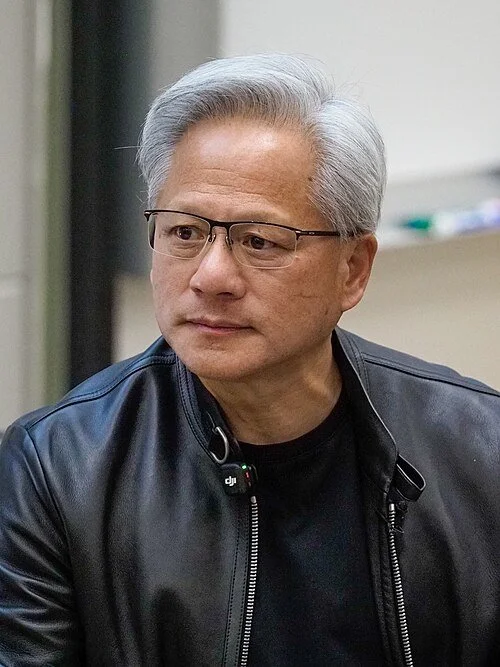
Anderseidesvik, CC BY-SA 4.0, via Wikimedia Commons
Why Jensen Huang is a Type 3
High-visibility keynotes used to reinforce authority and define the narrative. At Nvidia’s GTC conferences, Huang personally introduces new platforms and products in long-form presentations that blend technical detail with future-oriented vision. These events are highly produced and widely watched, with Huang functioning as both CEO and primary storyteller, shaping how Nvidia’s role in AI is understood publicly.
Early orientation toward high-performance environments and competitive fields. Huang trained as an electrical engineer at Oregon State University and Stanford University, then entered the semiconductor industry through roles at AMD and LSI Logic, both highly competitive, performance-driven environments. His early career choices consistently placed him in domains where success was measurable, comparative, and fast-moving.
Founding Nvidia to compete on performance and win a defined category. In 1993, Huang co-founded Nvidia with the explicit aim of building high-performance graphics processors. Early products were positioned around speed and capability, competing directly with established players. Jensen put it simply, “We decided we were going to be the best at something,” reflecting his confidence and orientation toward winning.
Surviving near-failure through competitive repositioning and execution. In the late 1990s, Nvidia faced existential risk after early product missteps nearly bankrupted the company. Huang led a rapid pivot toward a unified Graphics Processing Unit architecture (GeForce 256), which he described as “the world’s first GPU.” The reframing was not just technical but strategic, redefining the category and positioning Nvidia as its leader. The move stabilized the company and established a new competitive benchmark.
Systematic use of performance benchmarks to assert market leadership. Across product launches, Nvidia consistently emphasizes measurable superiority (speed, efficiency, and scale) often in direct comparison to competitors. Keynotes and product materials highlight benchmarks and performance gains, reinforcing a narrative of dominance and quantitative superiority.
Repositioning Nvidia from graphics company to AI infrastructure leader. Huang led Nvidia’s shift from gaming graphics into general-purpose and AI computing, recognizing early that GPUs could power machine learning workloads. He repeatedly framed this transition as foundational to the future of computing, positioning Nvidia at the center of a larger technological shift. This move dramatically expanded the company’s scale and relevance.
Personal branding aligned with consistency, recognizability, and authority. Huang’s signature black leather jacket, worn consistently at public appearances, has become a recognizable part of his identity. This repeated visual choice reinforces continuity and distinctiveness, making him immediately identifiable in high-visibility settings.
Relentless internal standard that keeps success from feeling complete. Huang has described growing up with parents who rarely praised him and instead focused on what could be improved, an orientation he says stayed with him. Even after Nvidia became enormously successful, he continued to emphasize what remained unfinished. The pattern suggests an internal standard in which accomplishment quickly becomes the new baseline and attention shifts toward the next level of performance.
Identity built around enduring difficulty and emerging stronger. Huang speaks openly about the “pain and suffering,” embarrassment, and shame involved in building Nvidia, and has said that knowing in advance how hard it would be might have stopped him from starting the company at all. Yet he also frames those experiences as formative, arguing that struggle made him a better leader. His self-concept is closely tied not merely to succeeding, but to proving that he can absorb failure, adapt, and continue performing through circumstances that might defeat others.
Demand for high performance paired with unusually little managerial cushioning. Huang maintains an unusually large group of direct reports and has explained that people reporting to him should already be “at the top of their game” and require very little pampering. His leadership style places substantial emphasis on capability, speed, and personal responsibility.
Continue Exploring
Type 3 Profiles (With Evidence): Taylor Swift, Tiger Woods, Elon Musk, Madonna, Serena Williams, Barack Obama
Understand Type 3: Type 3 The Achiever
Common Type 3 Mistypes (and how to tell the difference): Type 3 vs Type 7, Type 3 vs Type 9
All Celebrity Types: Hundreds of Profiles (With Evidence)
Enneagram Community (live teaching and discussion twice monthly): Enneagram Library Live