
Frida Kahlo: Enneagram 4w3
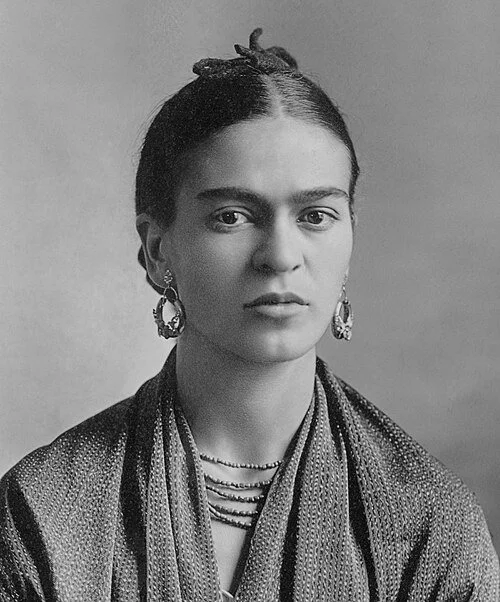
Guillermo Kahlo, Public domain, via Wikimedia Commons
Why Frida Kahlo is a Type 4
Painting herself into existence after physical rupture. At 18, Kahlo was seriously injured when the bus she was riding collided with a streetcar. Confined to bed for months, she painted with a specially constructed easel while looking into a mirror installed above her. Her first self-portrait followed in 1926. When the life she had imagined was physically interrupted, she responded by making herself the central subject of a new life. Across ~60 self-portraits, she repeatedly reconstructed her identity as her body, relationships, appearance, and emotional circumstances changed.
Creative expression experienced as a psychological necessity. Kahlo described painting as something she did because she needed to, without subordinating what passed through her mind to outside considerations. Her subjects were her sensations, states of mind, and profound reactions to experience, which she objectified in figures of herself. Art was not primarily an intellectual program or a performance intended to establish an artistic persona. It was the most sincere method she had for moving her inner experience into visible form.
Using fantasy to make subjective reality more exact. Kahlo was not constrained by the literal appearance of events. She painted exposed hearts, floating organs, doubled bodies, roots growing from people, Diego Rivera embedded in her forehead, and memories suspended in bathwater. These elements allowed emotional and psychological realities to become more precise than an ordinary depiction could make them. In her work, fact and fantasy coexist as equally valid forms of experience. If something was felt deeply enough, it belonged in the picture as though it physically existed.
Refusal to let an artistic movement define her inner world. André Breton promoted Kahlo as a natural Surrealist, but she resisted the classification. Although her paintings shared Surrealism’s dreamlike imagery, she did not experience them as products of theory, dreams, or participation in someone else’s movement. She called them the frankest expression of herself and insisted that she painted her own reality.
Turning physical pain into a personal symbolic language. In The Broken Column, Kahlo depicts her torso split open, her spine replaced by a fractured classical column, and nails piercing her skin. Tears cover her face, yet she looks directly outward rather than turning away. The painting converts an invisible bodily experience into a precise symbolic identity. Pain is part of the language through which that life can be understood. Her work repeatedly enters physical darkness and returns with images capable of communicating what ordinary description cannot.
Refusal to conceal reproductive grief. After suffering a miscarriage in Detroit in 1932, Kahlo painted Henry Ford Hospital. She portrays herself bleeding on a hospital bed, connected by red cords to a fetus and objects associated with pregnancy, anatomy, and loss.
Giving literal form to divided identity. Kahlo painted The Two Fridas during the year of her divorce from Diego Rivera. One Frida wears European clothing while the other wears Tehuana dress; their exposed hearts are connected, but one is wounded and bleeding. Instead of simplifying herself into a coherent public identity, Kahlo makes the contradiction itself the subject. European and Mexican inheritance, attachment and separation, strength and abandonment, external composure and internal hemorrhaging all remain present simultaneously.
Experiencing love as an attachment to the core of identity. Kahlo’s relationship with Rivera was marked by affairs, jealousy, separation, divorce, and remarriage, yet he remained one of the central figures in her emotional world. In Self-Portrait as a Tehuana, also called Diego on My Mind, his image appears on her forehead as though he has become embedded in her consciousness. She repeatedly represented him as an internal presence (lover, antagonist, child, obsession, and source of injury). Romantic drama repeatedly entered and reorganized the emotional world of her paintings.
Constructing an unmistakable public identity. Kahlo’s Tehuana dresses, braided hair, flowers, jewelry, and emphasized unibrow formed an immediately recognizable visual language. Her appearance communicated Mexican heritage, political allegiance, femininity, disability, and artistic individuality. She carefully shaped an image that felt intensely personal while also functioning powerfully in photographs, exhibitions, and public appearances (this speaks to both her 4 Type and 3 Wing).
Transforming medical objects into extensions of herself. Kahlo did not keep her medical life separate from her artistic identity. She painted the plaster corsets required to support her spine with anatomical, religious, and communist imagery. After her leg was amputated, her prosthesis was fitted with a vivid red boot decorated with embroidery and bells. Objects designed to mark limitation and dependency became highly individualized creations. Even when forced into standardized medical equipment, she altered it until it belonged unmistakably to her.
Sharp aesthetic disdain for what felt culturally lifeless. During her years in the United States, Kahlo reacted strongly against aspects of American wealth, inequality, industrialism, and social culture. She described Americans as lacking sensibility and good taste and compared their faces to unbaked rolls. The remark is funny, cutting, and openly snobbish. She made little effort to disguise her contempt merely to appear agreeable.
Insisting on recognition as an artist in her own right. Kahlo was frequently introduced through her marriage to the already famous Rivera. A 1933 Detroit News article even described her as the wife of a master muralist who “dabbled” in art. Kahlo responded with playful competitiveness, saying that Rivera did well “for a little boy” but that she was the big artist (a strong indication of her 3 Wing).
Continue Exploring
Type 4 Profiles (With Evidence): Prince, Kesha, Michael Jackson, Bob Dylan
Understand Type 4: Type 4 The Individualist
Common Type 4 Mistypes (and how to tell the difference): Type 3 vs Type 4, Type 1 vs Type 4
All Celebrity Types: Hundreds of Profiles (With Evidence)
Enneagram Community (live teaching and discussion twice monthly): Enneagram Library Live