
Brad Pitt: Enneagram 3w4
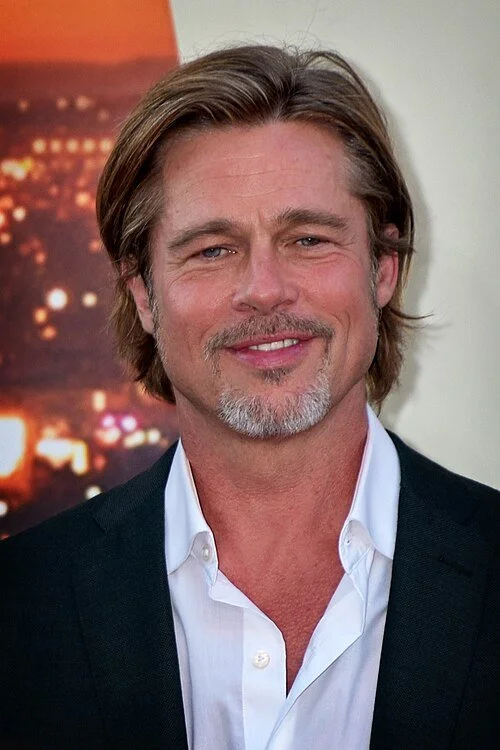
© Glenn Francis, CC BY-SA 4.0 via Wikimedia Commons
Why Brad Pitt is a Type 3
Precision in playing charismatic authority figures. Several of Pitt’s strongest performances hinge on characters whose confidence organizes the scene around them. In Inglourious Basterds his Lt. Aldo Raine dominates through exaggerated Southern cadence and theatrical command of his squad. A similar dynamic appears in Ocean's Eleven, where Rusty Ryan operates as a relaxed strategist guiding a complex operation. Directors have noted Pitt’s attention to rhythm, timing, and body language in establishing authority on screen. The result is a calibrated mix of charm and command, with characters who quietly control the flow of events around them.
Repeated reinvention of his on-screen persona. Across three decades, Pitt has avoided settling into a single recognizable acting type, presenting sharply different identities from film to film. In Fight Club he played Tyler Durden, a volatile anti-consumerist provocateur; two years later in Ocean's Eleven he shifted to the understated strategist Rusty Ryan; and in Moneyball he portrayed Billy Beane as a restrained executive under pressure. These roles are not variations on one archetype but distinct public identities with different rhythms and social energy. Critics have often noted Pitt’s awareness of how each role reshapes audience perception, producing a career built on controlled reinvention.
Building a parallel career through Plan B Entertainment. In 2001 Pitt co-founded the production company Plan B Entertainment. After his 2005 divorce from Jennifer Aniston, he assumed primary control and expanded the company’s ambitions. Plan B developed films that consistently entered awards conversations, including 12 Years a Slave, which won the Academy Award for Best Picture. Rather than functioning as a vanity label, the company became a durable prestige producer. Pitt’s long-term investment shows sustained interest in shaping successful projects behind the camera.
Awards-season performances calibrated for public likability. During the 2020 awards season, Pitt’s speeches blended humor, self-awareness, and controlled vulnerability. At the Screen Actors Guild Awards he joked about his dating life while thanking collaborators and acknowledging the collective nature of filmmaking. The relaxed delivery generated widely shared clips across social media. Observers noted how he balanced self-deprecation with confidence, maintaining goodwill among audiences and industry peers. Even brief public appearances functioned as moments to reinforce a warm, charismatic persona.
Publicly reframing a personal crisis as disciplined recovery. After Angelina Jolie filed for divorce in 2016, Pitt spoke openly about entering recovery and attending meetings with Alcoholics Anonymous. In a 2017 interview with the New York Times, he described the shift bluntly: “[I had] removed my drinking privileges.” The phrasing framed the problem in practical, managerial terms. He presented the period as deliberate reconstruction following a personal collapse. Public discussion emphasized accountability and rebuilding rather than withdrawal from public life.
Turning setbacks into a narrative of rebuilding. Coverage of Pitt’s recovery highlighted his willingness to treat the process experimentally. He described attending meetings where participants spoke candidly about failure and said the openness was striking. In interviews he framed the period as a chance to rebuild habits and priorities from the ground up. The storyline that followed, collapse followed by deliberate repair, became part of how his later career phase was understood.
Seeking credibility in design through collaboration with master craftsmen. In 2012, Pitt unveiled a furniture collection created with craftsman Frank Pollaro, introduced through coverage in Architectural Digest. The project emphasized traditional craftsmanship and high-end materials rather than celebrity novelty. Pollaro’s workshop translated Pitt’s sketches into finished pieces using techniques associated with museum-quality furniture. The collaboration positioned Pitt within the ecosystem of luxury design.
Building a prestige wine brand through respected partners. The rosé produced at the Château Miraval estate became one of the most visible celebrity wine ventures of the 2010s. Pitt and Jolie partnered with the Perrin family, proprietors of Château de Beaucastel, a highly respected Rhône Valley winery. Their involvement anchored the wine within the serious Provençal rosé market rather than a novelty label. Early vintages sold quickly and received strong reviews.
Serial expansion into new entrepreneurial ventures. Beyond film and wine, Pitt has repeatedly launched projects in other sectors. In 2019 he co-founded the luxury clothing label God's True Cashmere with Sat Hari Khalsa. The brand positioned itself around premium materials and understated design, later expanding through collaborations, including one with Harley-Davidson. Taken together with his film production and wine business, the pattern resembles portfolio building across multiple industries rather than reliance on acting alone.
Continue Exploring
Type 3 Profiles (With Evidence): Taylor Swift, Tiger Woods, Elon Musk, Madonna, Serena Williams, Barack Obama
Understand Type 3: Type 3 The Achiever
Common Type 3 Mistypes (and how to tell the difference): Type 3 vs Type 7, Type 3 vs Type 9
All Celebrity Types: Hundreds of Profiles (With Evidence)
Enneagram Community (live teaching and discussion twice monthly): Enneagram Library Live