
Yayoi Kusama: Enneagram 5w4
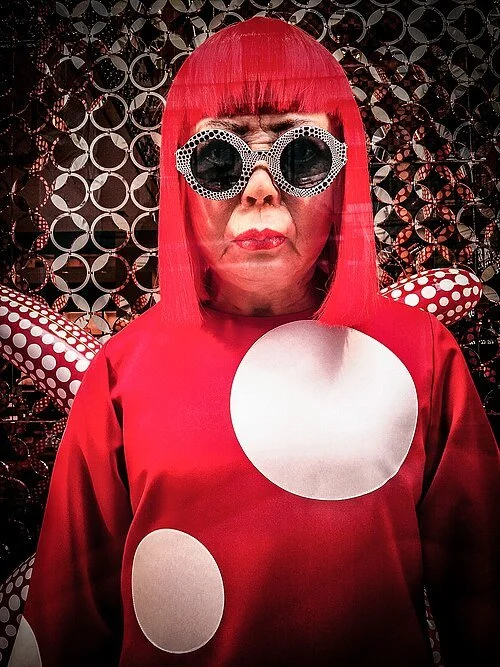
Why Yayoi Kusama is a Type 5
Orientation toward an internally generated world of perception and fascination. From childhood, Kusama described seeing fields of dots, flowers multiplying endlessly, and objects dissolving into repeating patterns. She has recounted moments of panic when these visions overwhelmed her, such as feeling surrounded by proliferating forms she could not escape. She has continued to focus on observing, understanding, and recreating these patterns through her work.
In-the-head communication style even when discussing emotional material. In interviews and public appearances, Kusama often speaks in a monotone and highly controlled manner, even when describing distressing or intimate experiences. When discussing hallucinations, fear, or longing, her language remains structured and deliberate, prioritizing explanation over emotional expression. The effect is a presentation of deeply personal material that remains cognitively organized rather than affectively driven.
Use of complex, eccentric systems to translate and understand internal experience. Kusama’s paintings, sculptures, and installations repeatedly rely on dense, intricate systems such as infinite dots, mirrored reflections, and immersive environments. These works often present visual fields that feel warped, excessive, or disorienting. Her emphasis is on fully rendering the complexity of her perception, even when it becomes visually overwhelming or unconventional.
Artistic practice driven by fascination and experimentation. Throughout her career, Kusama has pursued a wide range of experimental forms, including performance art, immersive installations, and unconventional materials. In the 1960s, she staged public happenings in New York involving nudity and body painting, including events in locations such as Central Park.
Deliberate nonconformity within established artistic environments. While working in New York City alongside prominent avant-garde artists, Kusama maintained a distinctly independent approach. Her work did not align cleanly with a single movement, and she often operated outside the central structures of recognition and affiliation.
Life structured to support sustained immersion in a private mental environment. Since the 1970s, Kusama has lived voluntarily in a psychiatric hospital in Tokyo, maintaining a daily routine of working in a nearby studio. This arrangement allows her to remain in a controlled and consistent environment while continuing to produce art rooted in her internal experiences. Her lifestyle reflects a prioritization of maintaining access to her inner world over engaging in a more externally driven or socially integrated life.
Translation of a highly personal and abstract inner world into shareable experiences. Through installations such as her Infinity Mirror Rooms, Kusama has created environments that allow others to enter and experience versions of her perceptual world. These works do not rely on narrative explanation but instead present structured environments that replicate the sense of endlessness and repetition she describes. The result is a direct transmission of a private mental landscape into a public, immersive form.
Garry Knight, CC BY 2.0, via Wikimedia Commons
Continue Exploring
Type 5 Profiles (With Evidence): Bill Gates, John Cage, J.R.R. Tolkien, Mark Zuckerberg
Understand Type 5: Type 5 The Investigator
Common Type 6 Mistypes (and how to tell the difference): Type 3 vs Type 5, Type 1 vs Type 5
All Celebrity Types: Hundreds of Profiles (With Evidence)
Enneagram Community (live teaching and discussion twice monthly): Enneagram Library Live