
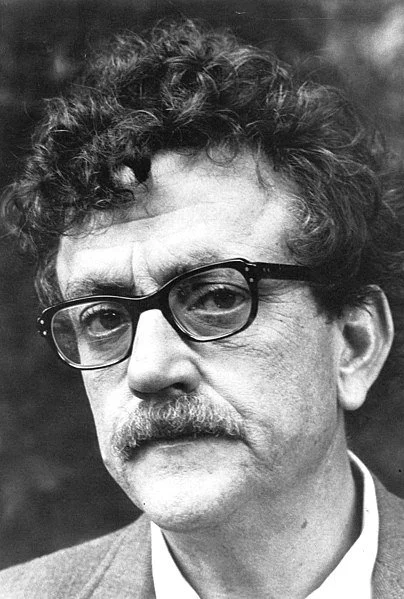
Photo of Kurt Vonnegut from an appearance on WNET-TV
Why we think Kurt Vonnegut is a Type 5
Emotional detachment and the phrase “so it goes”. Vonnegut gravitated toward the realm of thought over feelings. He used irony, satire, and humor, which had the effect of creating distance from the emotional weight of the subjects he addressed. For example, in Slaughterhouse-Five, the protagonist Billy Pilgrim is portrayed as a passive observer rather than an active participant. He has an aloof calmness when facing traumas, enduring them in a seemingly emotionless manner. Billy consistently uses the phrase "So it goes" in response to death. This repeated refrain encapsulates Billy's indifference and resignation towards the concept of mortality. It is the epitome of his emotional numbness, showcasing his disconnect from the harrowing realities of life and death.
Introverted and detached nature. As a writer, Vonnegut spent much of his time in solitude, reflecting, observing, and then creating based on his observations. He was very much an observer of the human condition. In a 1973 interview with Playboy, Vonnegut shared, "I was happiest when I was all alone — and it's very unhealthy." He also frequently expressed feelings of alienation and loneliness in his work, as can be seen in the character of Eliot Rosewater in God Bless You, Mr. Rosewater and Slaughterhouse-Five.
Eccentric persona. Vonnegut's public persona was marked by his ironic, self-deprecating humor and his visually distinct appearance, especially in his later years, with his tousled hair, bushy mustache, and his ever-present cigarette.
Desire for knowledge and obsessive focus. His persistent exploration of themes such as free will, the nature of humanity, and the absurdity of war in his works is a reflection of his desire and willingness to go really deep on subjects of interest. He also had a knack for presenting complex ideas in an approachable way.
Experimental in contorting reality for his satirical stories. In many of his works, Vonnegut employed a non-linear narrative style that jumps around different periods. An iconic example is Slaughterhouse-Five where the protagonist, Billy Pilgrim, becomes "unstuck in time" and experiences his life events in a disordered sequence. This time-traveling element twists the conventional conception of reality and offers a fresh perspective on the effects of trauma and the nature of human existence.
Dark humor. In Cat's Cradle, the central idea is the concept of "Ice-Nine," a substance that can freeze all water on Earth. His message is a darkly humorous critique of the arms race and the recklessness with which humans can weaponize scientific discoveries. In the book, humanity eventually faces annihilation due to Ice-Nine. This absurdity underlines the potential impact of unchecked technological progress.
Cerebral style. Vonnegut had a distinct manner of speaking that matched his writing – dry, ironic, and deeply insightful. He had a love of exploring intellectual pursuits (including science, technology, politics, and religion, though he himself was mostly anti-religion) and when sharing about them, he would come across as speaking from the head.
Kurt Vonnegut quotes that show he is a Type 5
“All my books can be interpreted as ethnography.”
“...As an anthropologist I learned to stand outside of my own society and people have said that I am like a Martian visiting the earth…”
“...I've discovered that many people are totally incapable of doing this. It's a parlor trick completely beyond them. ...Asking them to stand outside of their culture is like asking them to stand outside their skin.”
"Peculiar travel suggestions are dancing lessons from God.”
"I want to stay as close to the edge as I can without going over. Out on the edge you see all kinds of things you can't see from the center."
"So, in the interests of survival, they trained themselves to be agreeing machines instead of thinking machines. All their minds had to do was to discover what other people were thinking, and then they thought that, too."
“Science is magic that works.”
"Beware of the man who works hard to learn something, learns it, and finds himself no wiser than before."