
Adolf Hitler: Enneagram 6w5
Why Adolf Hitler is a Type 6
Conflicted relationship with authority in childhood. Biographical accounts of Hitler’s childhood in Braunau and Linz describe persistent clashes with his father, Alois Hitler, particularly during the mid-1890s when Alois insisted that his son pursue a civil-service career. Teachers and relatives later recalled that the young Hitler resisted school discipline and reacted strongly to criticism or imposed expectations. At the same time, he grew up in a household defined by rigid hierarchy and rules. This early pattern combined resentment toward controlling authority with deep exposure to strict order. The tension between resisting authority figures while organizing life around rigid structures appears repeatedly in his adult political behavior.
Years of isolation and precarity in Vienna (1909–1913). After failing twice to gain admission to the Academy of Fine Arts Vienna in 1907 and 1908, Hitler drifted into a period of poverty in Vienna. By 1909 he was staying in municipal homeless shelters and later a men’s dormitory on Meldemannstraße, supporting himself by selling small watercolor paintings. Residents of the dormitory later described him as withdrawn and solitary, spending long stretches reading newspapers or discussing politics with only a few acquaintances. The years were marked by instability, marginal social status, and limited prospects. When he later entered politics, he framed his rise in language of redemption from humiliation and vulnerability.
“A stray dog looking for a master.” In 1919 Hitler was still serving as a soldier assigned to propaganda duties in Munich under Captain Karl Mayr. Mayr later recalled that his first impression of Hitler was “like a tired stray dog looking for a master.” The remark referred to Hitler’s intense eagerness to attach himself to a political mission after Germany’s defeat. Within months he had joined the small German Workers’ Party and began speaking on its behalf. The episode suggests a man seeking a structure that could provide meaning, identity, and direction during a period of national and personal uncertainty.
A betrayal narrative crystallized after Germany’s defeat in 1918. Hitler later described learning of Germany’s collapse during the final days of World War I while recovering from temporary blindness in a military hospital in Pasewalk. In his account, the emotional shock of defeat quickly fused with the belief that Germany had been undermined by internal treachery. He returned repeatedly to the claim that the nation had been “stabbed in the back” by political enemies rather than defeated in open battle. This interpretation became a core explanation for national humiliation. It framed subsequent political activity as a struggle to expose and eliminate hidden betrayal.
Movement organized around the idea of internal enemies. During the early years of the Nazi Party in the 1920s, propaganda consistently emphasized the idea that Germany’s political system had been captured by conspiratorial forces. The “stab-in-the-back” narrative blamed Marxists, democratic politicians, and Jews for the collapse of the imperial government and the creation of the Weimar Republic. Party speeches and publications trained followers to interpret political events through the lens of hidden sabotage. The rhetoric encouraged vigilance toward neighbors, institutions, and cultural figures suspected of undermining the nation. Suspicion of concealed domestic enemies became a central organizing principle of the movement.
Loyalty oath tying the state directly to his person. After the death of Paul von Hindenburg in August 1934, Hitler merged the offices of president and chancellor and required members of the armed forces to swear a personal oath of allegiance to him. Soldiers no longer pledged loyalty to the constitution or the German state. The new oath bound them directly to Hitler as leader. This change transformed institutional duty into personal commitment. By restructuring loyalty in this way, the regime elevated obedience and framed disloyalty as a betrayal of the political order itself.
Violent pre-emptive purge of perceived internal threats. Between June 30 and July 2, 1934, Hitler authorized the purge known as the Night of the Long Knives. Leaders of the SA, including Ernst Röhm, were arrested and executed along with several political opponents. Hitler justified the operation by claiming that Röhm and others were preparing a coup. The killings were presented as an emergency measure to protect the state from treason. By framing the purge as defensive action against betrayal, the regime reinforced the idea that vigilance against internal enemies justified extraordinary violence.
Security framing of Jews as covert saboteurs. Nazi leadership documents and speeches frequently described Jews as, not only a disliked minority, but a hidden destabilizing force. At the postwar Nuremberg Trials, prosecutors presented numerous records showing officials characterizing Jews as saboteurs working inside Germany to weaken society and government. The language portrayed persecution as a form of national self-protection. Policies of exclusion and violence were framed as preventive measures against alleged internal sabotage. This security narrative allowed ideological hostility to be presented as defensive necessity.
Governance structured to prevent independent power centers. Historians of the Nazi regime often describe how Hitler encouraged overlapping responsibilities among ministries and party offices. Senior figures such as Hermann Göring and Joseph Goebbels operated in partially competing spheres of authority. Contradictory instructions and unclear jurisdictions forced officials to seek guidance from Hitler personally. The arrangement discouraged cooperation among subordinates and made independent power bases difficult to build. Political survival depended on demonstrating loyalty and remaining aligned with the leader’s expectations.
Cabinet government gradually hollowed out. After the late 1930s, the German cabinet rarely met as a functioning body. By around 1938 major decisions were increasingly made through informal channels rather than collective deliberation among ministers. Hitler discouraged independent meetings between senior officials that might create unified positions or coordinated resistance. Government departments operated in parallel rather than through structured collaboration. The absence of regular cabinet debate concentrated authority in the leader’s hands and reduced opportunities for institutional checks.
Control of information through trusted gatekeepers. Within Hitler’s headquarters, access and paperwork were increasingly managed by Martin Bormann. Bormann supervised appointments, controlled documents reaching Hitler’s desk, and regulated who could see him. Several contemporaries later described how this gatekeeping turned proximity into a political resource. Officials seeking influence needed to maintain favor with the small circle controlling access. The arrangement narrowed the flow of information reaching Hitler and reinforced a system where loyalty to the inner circle shaped political outcomes.
Betrayal narrative during the July 20 conspiracy. On July 20, 1944, German officers attempted to assassinate Hitler in the plot known as the July 20 Plot. After surviving the bomb explosion, Hitler ordered sweeping reprisals. Investigators arrested thousands of suspects and associates, many of whom were executed following trials before the People's Court (Nazi Germany). The purge extended beyond the conspirators themselves to individuals suspected of sympathy. The episode intensified the regime’s fixation on hidden betrayal within the military and bureaucracy.
Interpreting defeat through treachery in the bunker. In the final months of 1945, Hitler withdrew to the underground headquarters known as the Führerbunker in Berlin. Witnesses including secretary Traudl Junge later described conversations in which Hitler attributed Germany’s collapsing military situation to betrayal and disobedience. The failure of planned counterattacks, such as those expected from General Felix Steiner’s units, was interpreted as proof that commanders had abandoned him. Even long-time associates such as Heinrich Himmler became targets of suspicion when rumors surfaced about separate negotiations with the Allies. The final days were marked by escalating accusations that trusted insiders had never truly been loyal.
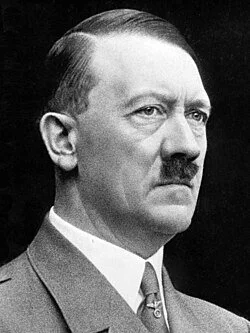
Bundesarchiv, Bild 183-S33882 / CC BY-SA 3.0 DE via Wikimedia Commons
Continue Exploring
Type 6 Profiles (With Evidence): Larry David, Bruce Springsteen, Woody Allen, Danny Glover
Understand Type 6: Type 6 The Loyalist
Common Type 6 Mistypes (and how to tell the difference): Type 3 vs Type 6, Type 6 vs Type 9
All Celebrity Types: Hundreds of Profiles (With Evidence)
Enneagram Community (live teaching and discussion twice monthly): Enneagram Library Live