
The Upbuild Enneagram Library
Enneagram Typing, Mistyping, and the Wings
Subscribe on: Apple Podcasts, Spotify, YouTube, or wherever you get your podcasts

Episode Description
Typing is one of the most critical skills for any user of the Enneagram. In this episode, we dive deep into the factors that contribute to understanding how to type and talk about the two biggest obstacles to typing correctly. We discuss the impact of the ego, the influence of the Wing, and the problem with Enneagram tests. We close this episode by giving you our three most impactful tips for how to type accurately.
Podcast Hosts: Rasanath Das and Hari Prasada Das
Listen to this episode on Apple, Spotify, or your preferred podcast platform
Highlights
[2:30] The two biggest obstacles to typing correctly
[2:50] The ego as an obstacle
[4:30] The casual approach to typing
[6:00] The problem with Enneagram tests
[7:50] “Although all 9 Types are equal, when you find your Type, you think it’s the worst one.” Richard Rohr
[8:10] It takes tearing muscle to build muscle
[8:45] The importance of consciousness and aligning with the real self, rather than the ego
[10:00] The Enneagram holds up a mirror to the identities that we are attached to
[10:45] “The Enneagram does not put us in a box, it shows us the box we are already in—and the way out.”(Riso and Hudson)
[11:15] This podcast offers a taste of the Upbuild workshop experience
[14:10] Three ways to identify Type
[15:00] The Basic Fear. The fear of not being enough of my Essence Qualities.
[16:30] Typing using the trajectory in consciousness
[20:00] Typing using the body language, which is the most reliable indicator
[24:30] Enneagram Wings

-
This is an automated transcript and may contain minor errors.
Rasanath: Hello everyone. Welcome to the Enneagram series. I'm Rasanath I'm here with Hari Prasada. And today we are going to talk about how do we type ourselves based on the knowledge of the Enneagram. And we, particularly at Upal, we feel that this topic deserves multiple sessions because the effectiveness of the framework is.
Only as good as the accuracy of the typing, which means that we have to take the process of typing very seriously. The challenge with any personality typology is that, uh, there is an energy around. The typing process, which is we wanna understand who we are, we wanna understand other people and what their type is.
And also to perhaps in, in a not so serious way, just share what our types are. And we just wanna bring some attention to, again, why we think. The typing process is so critical and so important. Hi, Hari Prasada. You are extremely passionate about this. I'm, I'm, and I see how ly it shows up in any conversation around the Enneagram.
So my first question for you is, how should our audience look at the typing process?
Hari Prasada: Well, I, I think you alluded to this. But I've been writing a lot about this in an Enneagram book that we're working on. There are two obstacles to typing that became very clear through my writing process. One is the ego or the identity of who we think we should be rather than who we are.
And the other is a casual approach to typing. Both of them overlap very much. It's not that there's no relationship between them, but the, the ego is problematic because we want to see ourselves a certain way, and so yeah, yeah, yeah. I'm that type, I'm that type because that sounds great. Or like, I really see those good qualities that everybody loves about me in that type.
That may not be my type. That's a projection. It may be based on some evidence circumstantially, but it's not speaking to the big picture. It's just a slice of the picture. It's not to say that it's all false and needs to be thrown out, but the way I wish to be perceived or what gets me validation is not the full picture of who I am.
So the ego gets in the way because we all have an image. We all wish that we could just like take the types. It's like when you pull numbers out of a hat and you have nine types in a hat, it's like, well, I hope I get number two, or I hope I get number five. I would like to be that. It's not about what you would like to be, it's about what you are.
So we have to remove the ego and be willing to see some of the shadows. That are preventing me from accepting myself and making me want to be something else, making me want to be something that looks easier or better or whatever it is closer to our image of how we'd like to think of ourselves. So that's number one.
The ego is an obstacle. And number two is the casual approach to typing, which is, I just wanna have fun with this. Like it's another framework that's cool to be. Throw around with my friends or in the office and like, ain't it cool? You know it's, oh, I did you hear? This person's a seven. I'm an eight.
You're a nine. Really? Awesome. Wow. That means you're like this and I'm like this. And when we get together it's like this really awesome, awesome, right? It's not like that. I mean, there's some element of fun to it, but it runs deep. It exposes us. It shows us what we're missing about ourselves, what we're missing about each other, and how to understand ourselves and each other and better ourselves, better our relationships, better our consciousness and our lives.
Right? So that's not a casual thing. It has, its fun, but if we approach it in a casual way, it will actually mislead us. Mm-hmm. And will never reap the benefits. So that is the second, uh, obstacle. And of course, why do we take a casual approach? Well, the ego wants things to be lighter and freer and more a certain comfort level for us, right?
Uh, and, and we want the thrill more than we want the depth of fulfillment and the transformative power. So people go about typing with those two obstacles. Way more often than really sincerely looking to grasp what their type is. And one way, which you mentioned that, that shows up is by taking an Enneagram test.
It's really easy. Many of them are free, and it's fun and it allows me to answer questions and feel like I'm, I know myself, or I'm getting to know myself more through the questions. Then I come out with a type at the end, and that has both of these problems to
Rasanath: them. The one other thing that I also can attribute to the ego is we like to think of ourselves as pretty self-aware, even when we're not, and sometimes the Enneagram framework can be a pretty rude awakening to the fact that.
We actually don't know ourselves all that well, and that can again, pose some challenges around and not being in the learner's mindset, but just wanting to prove that I know myself and here's my type, versus really looking for things that I don't know. Yeah.
Hari Prasada: So it's also easier. To have a test spit back an answer of what my type is, or have a coach or somebody who knows the Enneagram or thinks they know the Enneagram, tell me I'm this type.
Then it is to discover what type I am and go through that process and we. Will not like, I will be very, very bold about this. We will not like what we find when we find our type. Uh, and I often quote Richard Rohr on this, that though all nine types on the Enneagram are equal. When you find your actual type, you will think mine is the worst one.
Right. So that goes against the feeling of fun and comfort and like, this is great. It is great. It is fun. But it takes tearing muscle to build muscle as a, I also love to share that the metaphor is so critical that going into the Enneagram with too light of an approach only leads to confusion and more ego stuff going on.
But when we recognize that. We have a lot to work on, and we get hungry to do that work and discover our potential that lies beyond our present limits, our present limitations, then it's amazing what happens. It's incredible. So the bottom line is consciousness, right? We've been talking about levels of consciousness.
We know that consciousness is really the underpinning of the entire Enneagram and of all of our work at Up build. Aligning with the real self versus the ego or the projection of who I think I should be. So why would it not be the case in approaching typing? It's all about consciousness. Am I ready? Am I eager to know myself?
Am I courageous enough to go there?
Rasanath: Yeah, I have heard in so many typing conversations around the language around, well. Those are the types that I didn't really resonate with. And sometimes I have to ask the question, well, what did you mean by resonance? And, uh, in some cases, in many cases, you would discover that resonance essentially meant that, well, I didn't like what I, I didn't like what I read.
And so I'm not resonating, which means, you know, resonance around, like, I wanna feel good about myself when I. And that's the whole reason why I embarked on this process is 'cause I, I wanted to feel good about myself. And the Enneagram is not promising that it, it'll, if we choose to be sincere, hold up a, a mirror and the mirror will show.
What we have identified ourselves with so strongly, so unconsciously, and the patterns showing up in our day-to-day interactions, which many times is not very pretty to look at.
Hari Prasada: Yeah. So there's so much resistance that we have to become aware of before we go about the process of typing. And it's on many different levels.
And I love what our teacher Russ says. The Enneagram is not putting you in a box. We're so afraid that our type means we're being put in a box or we are putting other people into boxes. No, the Enneagram does not put you in a box. Rather, it shows you the box you're already in and it shows you the way out.
Rasanath: So as we are building the series on the Enneagram would really want for our audience to learn. More about themselves through the lens of D Ngram. How do we suggest that they use the series as we speak about the types?
Hari Prasada: This podcast series is meant to offer a taste of our workshop experience, and of course, asynchronously on your own time and as a resource that you can keep returning to because people go through our workshops multiple times.
People read our content. Again and again, we read the same content again and again, including our content, and we're learning so much because it's not coming from us. It's coming from a wisdom bank that is so extraordinary and gives so much rich insight and potential for strong personal realization that the more you engage.
The more you'll grasp and the deeper you'll go and you hear one thing one day and you have one lens, and then you hear it another day and you have a completely different lens and it suddenly hits you. We hear this all the time, so use this series to. Really engage with what could be your type and what could be the types of the people in your life.
So we don't just wanna know what our type is that's self-centered. That's the first thing we want because it's the basis for everything. It's our lens on everybody else, and it directly impacts everybody else. So it's the most important in one way, but it's very, very narrow. When it's only I care about myself and I don't care about the other people in my life.
So when I found my type, okay, I'm moving on and we see this, this happens a lot. That's true. It's a natural instinct. That's true. Like, okay, I got what I need. I got my type. What about everybody else? You're going to engage with countless people of all nine types. Are you ready for that? Are you equipped to best serve them, to really understand them?
With your heart and with your intelligence, and engage with them in the most constructive way. And that will also better your own life and your own depth of connection with yourself, what it brings out in you. So we want to look for our type in this series, and we also wanna look out for the people in our lives and keep returning to this content as it is helpful.
And you can also refer to our website. We lastly, will give three ways to identify your type and the types of people in your life that you can try on for size as you go through this podcast. And we hope that you'll go further beyond the podcast, that this will wet your appetite to know more and learn more.
Rasanath: Thank you. So please
Hari Prasada: share with us the three ways to identify your type. There are countless ways to identify your type. Every type has so many different attributes and so many different ways in which they can be identified, but there are three ways that we lean on most in our years of doing this work.
And then there's an additional piece that I'll mention afterwards. So the top three ways. We lean on amongst many others, but which simplify it and create an easy access for us. And for each of you is number one, the basic fear. Each type has a fear that drives them, that is actually at the core of all of their thoughts and all of their decisions, and it's fearing not being enough.
Of what we call their essence qualities. Mm-hmm. In other words, the gifts that they've been endowed with, the unique qualities that they know they're meant to experience and to exude, and the basic fear says, you're not enough. You're not enough of these qualities. You need to be more, you need to be better.
You better do something about it. And I will chase those qualities to the ends of the earth. By trying to do different things out in the world in the hopes that I can recover them, but it doesn't work. The basic fear doesn't actually allow me to achieve my essence. The the essence is within and fear is not going to bring it out.
So we all have all nine basic fears. They're universal, but one of them is pulling the strings on all the others. One fear is pulling the strings. On all eight others, and we have to become detectives to figure out what that one is. It's not as easy as you think. It's not obvious. One fear might strike us immediately and say, oh my God, that's totally me.
Yes, that is totally you, and it may not be your type because you have all nine of these fears, which one is actually deeper and at the heart of every other decision. So one is the basic fear. Two is the trajectory in consciousness. We've spoken about the levels of consciousness and how important it is to gauge where my consciousness is at and what we mean by trajectory of consciousness.
And also, of course, to grow the, the point is to grow our consciousness. But when we're talking about typing, we have to recognize that I behave differently in stress. In growth. I behave differently when I'm being challenged and when I'm feeling secure. I have certain key defense mechanisms that show up at different levels of consciousness.
There are different patterns. Mm-hmm. And I need to learn to recognize them. And when I do, I'll see actually there's a story to my type. Every type has its own individual story. That plays out through the trajectory and consciousness from creative to controlling, to destructive and back again or in any different way.
But we like to tell the story from creative to controlling to destructive, and then how to raise your consciousness from there because you see that it's fear. That is the seed in the creative consciousness that sends me to the controlling, that deepens and intensifies the fear and sends me into destructive where most intense and rules over me.
So you'll see that story is the story of your life in some way, and you have to be able to find yourself in the controlling consciousness because that is, that is us. Unless we've worked on ourselves so rigorously for so many years with such humility and uh, force to our desire to be ourselves, we are in the controlling consciousness.
And when we're in the creative consciousness, as we've talked about, we feel our controlling tendencies more intensely. It's a struggle and we tend to think that we're in the controlling consciousness. Because there's so much awareness of the controlling, so find yourself in the trajectory at the controlling level.
If you can't relate to the creative or you can't relate to the destructive, think, what would it be if I were at my best with nothing holding me back? That's you at the creative. And if you can't relate to the destructive, think what would it be? If I let go completely and I lost control? What is that like?
And we have glimpses of both. They're not, we're not a stranger to either of these. We may not stay in either of these for such long periods, but we definitely have regular experiences of both and. Don't make the mistake of thinking that you're in the creative consciousness because you know what it's like to be there.
We really want to focus on what are my controlling tendencies, and that will help us with number two, the trajectory and consciousness. So lastly, number three is the body language. And the body language seems to be the most external way to type. Seems to be the most external aspect, and it is external, but it is not superficial.
These types are energies that live in the body. We have all nine types. We have all nine energies within us, but one of them is our dominant and we are really just that type. And then we will talk in a moment that we also have a secondary driver and there are other dimensions to the Enneagram, but it's not just that we are all nine types, we have all nine energies.
We have an experience of all of them. One of them is so important and the body language is going to speak loudly as to what that predominant energy is. The energy of the type expresses itself through the body, unmistakably. It can't be faked. It's constantly communicating. I, I love to give the figure that 30% of what we are.
Speaking, the content of what we're speaking is what's being transmitted to others. Hmm. That means 70% is not the content, but body language tone, these other factors. And we, we group that into body language, the tone of, of the way we speak. We include that as part of the body language, part of the expression of the body.
And the body doesn't lie. So I find personally this is the most reliable indicator. It's really powerful.
Rasanath: It's also amazing how when you pay close attention to the body language, the types just leap out because it's, there is such a characteristic of the type that is encapsulated in the body language because so much of body language comes from our subconscious and unconscious.
We are not necessarily. We are not programming our body. Our body is being programmed by what's lying deeper, and that is exactly what the Enneagram is, is pointing towards.
Hari Prasada: Yeah. And when we work on our body language and we sculpt it. It's not without the filter of our natural body language. Even that is coming through a filter.
Rasanath: That's true. That is true. That is true there. So there is really no way to escape.
Hari Prasada: There is no way to escape. Sometimes it's hard to read the body language. Sometimes it could be this type or it could be this type where I get confused or it may seem atypical, but at the end of the day, when you figure it out, it almost always makes sense.
That's true. That is true, and if it doesn't make sense, then there are more questions to be asked. We need to make sure that it's the real type.
Rasanath: Yes. Excellent. We will be talking about each of these three ways as we go through. Each of the types. Of course, we could do a lot more with the body language when we do our workshop because we can show clips of famous people or even act certain things out for people to get the experience of body language.
But we'll do our best and engage to and discuss to really bring all the three ways to identify your type and explicitly speak about as we are going through every single type. The three ways are, again, the basic fear. Every type has a basic fear. It takes some detective work. To understand the basic fear, and we will go through the basic fear for each type.
The second is the trajectory in consciousness. How do I behave when I'm feeling secure? How do I behave when I feel insecure? Those behaviors have a a very particular characteristic and we will again discuss that the trajectory in consciousness for every single type in the series. And so nicely put that it is important for us to look at the controlling levels of consciousness more closely because that is usually where we will find our type.
99.9% of the time. Very good. And the third one is the body language. And again, we will do our best to give some clues for body language as we talk through each of the nine types in the Enneagram. And yes, you are going to talk about one other aspect and you said your secondary type, something to that effect.
So
Hari Prasada: yes,
Rasanath: take us
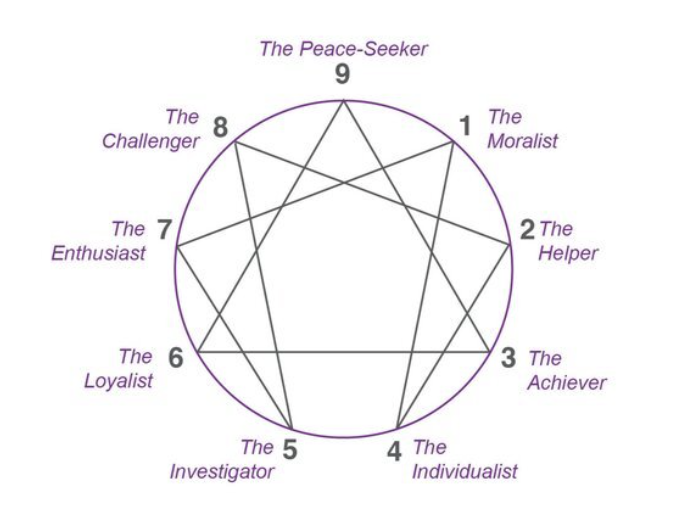
Hari Prasada: through that. So that is called the wing. There is a secondary type that is adjacent always to your primary type. That means that if you are a seven, you can have a six wing or an eight wing. You cannot be a seven with a one wing. You can't be a seven with a three wing. You can only be a seven with a six or a seven with an eight, you can be a nine with a one or a nine with an eight.
Three with a four or three with a two. So that's how the system works. And it works. My God, it works. It's, it's uncanny. It's unbelievable. So if you're not seeing that secondary driver, if you're not feeling the resonance with another type, that is almost as strong as your own, again, secondary lens on the world, secondary basic fear, secondary, everything.
Then you're not yet landing on your type. You will undoubtedly find that your type has a strong, strong wing. And it may be varying degrees or we may have exercised it to varying degrees, but it is there for sure, and we have to be able to clue in on that. And that's a strong indicator again of. Am I landing on the right type or not?
So if I've gone through the basic fear trajectory and consciousness, body language, one of those three of those all matches up, it's clear. And I think I know what my type is, but I can't relate to the two types that are adjacent or I think I'm both of the adjacent types. Something is not right. Right. Yes.
We have one wing. We also have some of the energy of the other wing. Yes. One is really the wing, so we want to gauge for that and, and pressure test for that.
Rasanath: Very good. Yeah. It's remarkable how, how ancient the system is and how, uh, structured it is from a point of view of taking us closer to understanding what our ego lenses and the wing is very fundamental.
To how structured, uh, the Enneagram system works. Excellent. Yes. Anything else to start now,
Hari Prasada: go out and use these tools. Use the framework of our tools for typing the top three ways to type, understanding that we have a wing and apply it to this series and beyond. And we hope that it serves you really, really well.
It's an amazing journey. We pray that you're up for it and that you have the best experience possible more and more and more throughout your life.
Rasanath: Thank you very much, and thank you to our audience. Hopefully this was very helpful for you in terms of really lining up your mindset as you go through this process of discovery, which for us, at a build that is the most important thing, is how you approach.
Uh, the process of discovery and that process is what will really lead us to. Where we need to get to.
Episode Transcript
Continue Exploring the Enneagram
Browse all Enneagram podcast episodes
Understand the Enneagram framework — clear breakdowns of the Types and how the system works
Join our live Enneagram community, Enneagram Library Live, hosted by the Upbuild team.
Take the two-day Enneagram 101 workshop