
Robert F. Kennedy: Enneagram 1w9
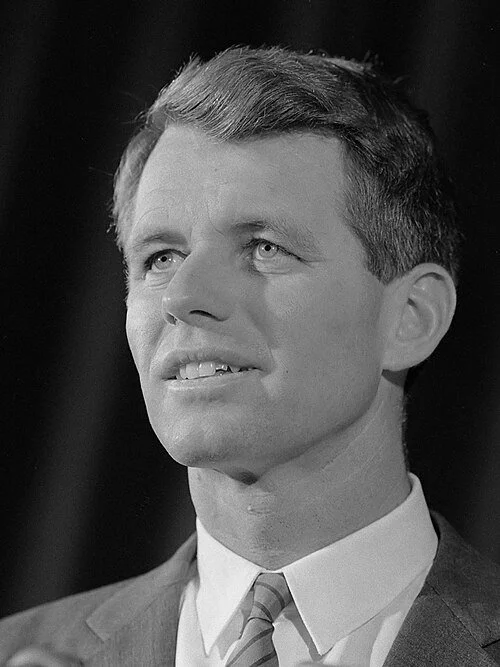
Jack de Nijs for Anefo, CC BY-SA 3.0 NL, via Wikimedia Commons
Why Robert F. Kennedy is a Type 1
A quiet child who did not mind being alone. Kennedy was the small, serious seventh child in a large and intensely competitive family. He recalled being awkward, quiet, and comfortable by himself. Friends from his school years described him as shy and subdued, with little of the easy social confidence associated with his older brothers. He did not seem driven to become the most entertaining person in the room. His presence was watchful and contained. As an adult, that reserve gave him a natural gravity. He spoke softly and could make an argument feel weighty without raising his voice.
An early refusal to join in with cruelty. At school, Kennedy disliked dirty jokes and bullying. A friend remembered that he would not imitate other boys simply to become more popular, and he once intervened when an older student picked on a younger one. His morality had a clean, almost boyish quality. He divided conduct into what was decent and what was not, then tried to stay on the decent side even when belonging would have been easier. His later political idealism grew out of the same instinct. He wanted public life to have standards and expected individuals to answer for how they treated people with less power.
A doer with a command of detail. Kennedy was most comfortable when a cause could be turned into assignments, deadlines, and action. He managed John Kennedy’s Senate and presidential campaigns with unusual intensity, building organizations that were disciplined, fast, and effective. The 1960 campaign began earlier and was better organized than earlier Democratic presidential campaigns. Staff members remembered that Robert would spot the question they had overlooked and press until it was answered. His offices could look chaotic, but the work moved. He had little patience for concern that never became a plan.
Anger at lying kept under control. Kennedy’s restrained manner covered a strong temper. During his Senate investigations, he said, “My biggest problem as counsel is to keep my temper.” Watching witnesses “lie and evade” made him “boil inside,” but he knew an outburst would hand the advantage to the witness. His self-control was deliberate. He felt anger quickly when he believed someone was corrupt, dishonest, or hiding behind power, then forced that anger into precise questions. The soft voice made the moral pressure more severe.
Going after organized crime with extraordinary conviction. As chief counsel to the Senate Rackets Committee and later as attorney general, Kennedy pursued organized crime and corruption with unusual force. His investigations exposed criminal influence within labor unions, and the Justice Department expanded its organized-crime work substantially under him. By 1964, federal juries had convicted more than a hundred Teamsters officers, members, or associates on charges including bribery, extortion, embezzlement, and fraud. The work carried political and personal risks, but intimidation did not make him retreat. He regarded corruption as a moral contamination that had to be removed.
Conviction that could harden into a vendetta. Kennedy’s certainty had a punitive side. His pursuit of Teamsters president Jimmy Hoffa became intensely personal, and critics viewed the dedicated “Get Hoffa” effort as an abuse of prosecutorial focus. In campaigns, Kennedy was known as the family’s hatchet man, handling confrontations so his brother could remain above them. He could be blunt, impatient, and ruthless when he decided someone stood in the way of the right outcome.
Treating civil rights as a federal duty. As attorney general, Kennedy increasingly used federal authority to enforce civil rights. He sent hundreds of federal marshals to protect the Freedom Riders and pressed for the desegregation of interstate travel. During the crisis over James Meredith’s admission to the University of Mississippi, he spent hours negotiating with Governor Ross Barnett while federal marshals protected Meredith’s right to enroll. His approach was careful and legalistic. He wanted order, but he also believed the law had to protect people whom local authorities refused to protect.
Grief that softened his rigidity. John Kennedy’s assassination altered Robert profoundly. He withdrew, read poetry and Greek tragedy, visited his brother’s grave, and tried to understand suffering rather than escape it. His daughter Kathleen remembered him saying that he was going to “dwell in the pain.” Friends saw a movement away from cold competitiveness and toward a deeper sensitivity to sorrow. He remained grave and demanding, but his moral language became less prosecutorial. Pain complicated his certainty and made compassion more central to the way he understood public responsibility.
Seeing suffering and needing to do something. As a teenager, Kennedy saw the poverty of East Boston tenements and asked why something could not be done. As a senator, he visited Appalachia, Native American reservations, urban neighborhoods, and the Mississippi Delta, where he encountered hungry and visibly malnourished children. The suffering left him brooding and angry, but he wanted more than concern. In Bedford-Stuyvesant, he helped create a development effort that brought community leaders together with businesses, universities, unions, foundations, and government. A colleague remembered his constant refrain. “We’ve got to get going. We’ve got to do something.”
Speaking against apartheid using the language of ideals. Kennedy traveled to South Africa in 1966 while apartheid’s defenders still treated anti-communism as a justification for supporting the regime. At the University of Cape Town, he argued that individual human dignity had to be the standard by which a society was judged. He also acknowledged America’s own racial failures, which kept the speech from becoming a lecture delivered from a position of innocence. “Each time a man stands up for an ideal,” he said, he sends out “a tiny ripple of hope.”
Continue Exploring
Type 1 Profiles (With Evidence): Bernie Sanders
Understand Type 1: Type 1 The Moralist
Common Type 3 Mistypes (and how to tell the difference): Type 3 vs Type 9, Type 2 vs Type 9
All Celebrity Types: Hundreds of Profiles (With Evidence)
Enneagram Community (live teaching and discussion twice monthly): Enneagram Library Live