
The Upbuild Enneagram Library
Type 1 Across the Dimensions
of the Enneagram
Subscribe on: Apple Podcasts, Spotify, YouTube, or wherever you get your podcasts

Episode Description
This compilation episode brings together our discussions of Type 1 across the many dimensions of the Enneagram to build a richer, more complete understanding of the Type. The team explores the 1’s deep desire to live according to higher principles, as well as their relationship with anger, perfectionism, activism, the Inner Critic, Wings, and patterns of growth and stress. They examine both the remarkable strengths of Type 1 and the internal struggles that can accompany the pursuit of goodness and integrity.
Podcast Hosts: Hari Prasada, Michael, Rasanath, and Vipin

Listen to this episode on Apple, Spotify, or your preferred podcast platform
Highlights
[00:50] Introducing the Enneagram Type One compilation
[02:20] The Body Center
[10:40] The Dutiful Behavioral Pattern
[11:50] The Directional Movements: toward Type 7 in growth and Type 4 in stress
[14:20] The Predominant Emotion: Anger
[17:30] The Wings: 1w9 vs. 1w2
[19:00] Parental Orientation: frustration with the protective function
[20:00] The 1’s Inner Critic
[27:20] The Harmonic Group: Competency
[28:30] The Achilles Heel: “I can’t accept my own impurity.”
[30:20] The Passion: Resentment, and the Virtue: Serenity
Quotes
“[The 1s] are here to bring good into the world, to experience goodness, and to share that with others.” - Hari Prasada
“[For the 1s] what's leading the way...is a gut feeling of what is right that I feel in my bones. I just know this is right.” - Hari Prasada
“[For the 1], what I want to do is set the bad to good, to set what's wrong right again.” - Hari Prasada
“1s teach by example.” - Rasanath
“The anger of the 1 is like a sniper. It's fired with precision...silent, but it hurts.” - Rasanath
Episode Transcript
-
Welcome to this special Enneagram compilation episode on the type one
Michael: In our podcast, we've explored the Enneagram through lots of different dimensions, including the centers of intelligence, behavioral patterns, predominant emotions, and many more. Each of these episodes looks at one particular dimension and explores how it shows up across all nine types.
For this episode, we've flipped that around and pulled together all the excerpts related to a single type to give you a deeper understanding of that type through the different dimensions we've covered. Since each clip comes from a longer conversation, in this episode, you'll be jumping into discussions that are already underway.
Between each section, you'll hear a brief chime and a quick introduction to the next dimension so you know where we're headed. Each dimension shines a light on something different. Put them together and you start to get a fuller picture of the type, including both its incredible gifts and the darker patterns that each type is called to recognize and gradually transform.
We hope you enjoy the journey. Over time, we'll also be releasing full-length episodes that explore each Enneagram type through these dimensions in greater depth.
Our first stop is the centers of intelligence, the dimension that helps us understand where each type primarily processes and responds to life. For type one, that's the body center, also called the gut center
Rasanath: The one is all about alignment and the sense of alignment when you think about the body is, you see, when we sit like this, you know, when we slouch. There is an experience of not being aligned.
when you look at the ones there is a, even in their posture, you actually feel a sense of like erectus. It's that everything in the body is actually aligned to what it needs to do,
Hari Prasada: They are here to bring good into the world, to experience goodness, and to share that with others. So they always have a cause that they're for, and that's something that they just feel in their gut what to align with. I just feel it in my gut and then I create rationale around it.
Ones think, oh, I'm very sensible. I'm very logical, I'm very objective. Uh, it's partially true, but it's actually, that's not what's leading the way. What's leading the way, and this is very subtle and very important, is a gut feeling of what is right that I feel in my bones. I just know this is right.
Oftentimes I'm right. Oftentimes I'm wrong. Depending on the level of consciousness that we're talking about, and according to the level of consciousness they have a very, very different result. There'll be an openness or assurity a confidence that is really powerful. That's at the upper end of consciousness, at the lower end of consciousness.
It's just a closeness and a squeeze, and a, you are not doing what's right. So I'm feeling that in my gut, but I'm not present and I'm giving all kinds of justifications. In terms of, well, this is logic. Here are the facts. I'm substantiating, but all of that is after I've made my decision, this is what we have to pay attention to.
I've already made my decision and now I'm backing it up. So it is not unbiased and objective in the way we might like to think. Now, it may be the right thing if the consciousness is high. But still, it comes from a gut place. And when I walk around sensing what's happening in the world, I see it in terms of right and wrong.
Now, this is not a bad thing. This is necessary, and everybody does this to some degree. The ones, they can't stop doing this in the most central, hardcore way. Everything I see, black, white, black, white, good, bad, right, wrong, good, bad, right, wrong. I've divided up the world that way. I may not have made the right decisions there.
I may not have figured that out, but there's this sense of I'm perceiving the world, I'm seeing how things are moving, and I'm classifying it right or wrong, good or bad. And what I wanna do is set the bad to good, to set what's wrong, right? Again. And I become an activist, whether it's as a grammar teacher, formally or informally.
I'm teaching everybody whether I have the role to play or whether I've chosen to just play that role in my relationship with you, or whether I'm out there protesting on the streets and leading the charge, leading a peaceful protest or a crazy riot. Ones are doing both of those things. Ones are doing all of these things and activist is sort of the quintessential word that characterizes the one.
And you see so many activists are actually ones, not all of them, of course, many are not, but it's very inherent to their nature. And what does it mean? To become active, to rise up, to move the energy of the world in the right direction. So that's what I'm sensing. Okay. Things are not going in the right direction.
I'm gonna rise up, I'm gonna become activated and start to set them right. You feel this bodily energy actually, even when they're speaking so intellectually, which they can do, and even when they're not about physical strength or bodily movement, you still feel the energy is coming from the body. It's this sense of wanting to be decisive, wanting to be ready, wanting to take a stand, and yeah, it's similar to the eight.
You have to get through me. You have to get through me and I have sharp logic that you're gonna have to pierce through. But the real thing is it's come from the gut. If you can break through my gut feeling, then you might be able to get to me.
Michael: I have this experience with ones as well that because of the identity around being a good and righteous and rational and logical person, there's a lot of attention given to thought and the mind.
So this can be a type that is quite surprised that they're in the body center because it can go completely against their identity to think about their decisions and their. Causes and what they're all about in this world, not coming from something that's been really well thought out through the mind.
So I'm appreciating how you are highlighting that here and hopefully that can be a wake up call. And also give the ones a sense of humility, which is sometimes important for them to get.
Hari Prasada: Yes. And the thing is they can be better thought out or their stances can be better thought out than those in the head center.
And they could be more passionate about them than those in the heart center, but where is it coming from? That is what we have to pay attention to, and that is the hardest thing because it's so subtle. And as you said, Michael, it often goes against the way I wanna see myself. One of the characteristics
Rasanath: of the eight, nine and one is their relationship to the emotion of anger.
And why it's so directly connected to the body, because amongst all the emotions, I would say one of the most prominent, dominant emotions that is felt by the physical body and expressed through the physical body is the emotional anger.
Anger is a characteristic that something has been violated. Something has crossed the boundaries that it shouldn't cross, and the body is actually setting the boundary.
So the anger, when we experience the emotion of anger, it is felt in the physical body very quickly. The ones express anger and the anger is, well, if things are not the right way, there is an expression of anger.
Michael: you mentioned about the nine having a little bit of trouble with that.
The challenge with that, because my identity is the peace seeker, the ones, they can also have a similar challenge with it because my identity is, I'm a good, righteous person, and so anger is not part of the equation when I think about being a good, righteous person, and yet when
Rasanath: somebody is doing something wrong, I can't
Hari Prasada: help but feel angry.
I may not acknowledge it in many cases. In many, many cases. I don't acknowledge it. I'm not angry. That's a classic one setup.
Michael: Yeah, and especially for a one with a nine wing or a nine with a one wing, you're gonna have a double version of what we're talking about here, where there's a lot of simmering anger.
But it can be hard to, for me to be in touch with that and even be honest with about it.
Our next stop is behavioral patterns. This dimension explores how each type tends to move through the world. Type one is one of the dutiful types
Rasanath: For the one, as we have described, it's about being subordinate or obedient to a higher principle.
And I'm constantly looking to see if I'm living according to the principle or not, if others are living according to the principle or not. And here's the equation. In order to help other people lift that principle, I have to live it perhaps even more than other people are living it once. Teach by example.
And so this is where am I giving more than am I receiving comes into play where I have to reach a certain standard of the principle before I can expect other people to live by the same standard, which means I have to do a lot of internal work in order to then go outside and change things. That's the equation.
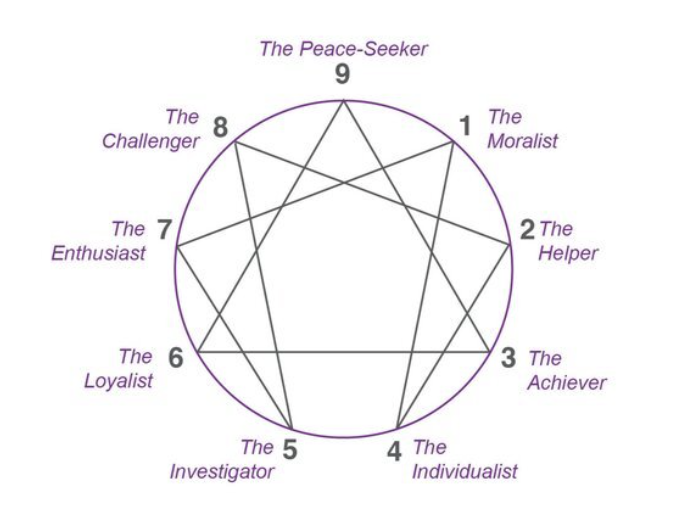
Next up are the directional movements, the dimension that helps us understand how each type tends to grow and what happens when they're under stress. For Type 1s, this means taking on some of the healthier qualities of Type 7, the Enthusiast, in growth, and some of the less healthy behaviors of Type 4, the Individualist, under stress
Hari Prasada: So the type one goes in growth towards the type seven. So one being the moralist, very principled, very structured, very dutiful towards a higher order of things, and wanting to be aligned with what's right and feeling very constrained and like the weight of the world is on my shoulders and.
I'm not getting it right and other people are not getting it right and they're the bane of my existence, and that there's this uprightness and uptightness so heavy, the gravest type on the Enneagram, I start to become freer and freer and freer, and there's a joyfulness, a levity, something beautiful. The ability to appreciate.
My own sincerity. The sincerity of others to feel compassion for myself, compassion for others, and to allow for people to be where they are while trying to inspire them to become better, more aligned with what's right, growing more, and therefore happier like the seven in stress, the ones they. Feeling this heaviness, this gravity, the weight of the world on their shoulders.
Nobody cares about what's right. I'm the only one sacrificing my life for what matters. I feel so alone and misunderstood, and I'm reviled for being the order keeper. I. Make sure that everybody falls into line and that every I is dotted and every T is crossed and nobody appreciates this about me. They actually don't like it about me.
And oh, it's so emotional and overwhelming, and how will I ever get out of this cloud? And nobody cares. Like the four,
Michael: the
Hari Prasada: individualist.
Michael:
Now let's turn to the predominant emotions, the dimension that helps us understand the core emotion that each type most centrally experiences.
For type ones, that predominant emotion is anger. Along with that comes a core mantra shared by the types in this triad, "Don't mess with my world."
Hari Prasada: So the one is experiencing this mantra, don't mess with my world.
Around their principles and the fact that I am a good person. I better be a good person. Otherwise, all hell breaks loose. If I don't have my identity as good and right, then who am I? I'm nothing. So you better not get in the way of my principles that make me right and. When you do, you'll feel the vitriol, the spewing of rage in a very, very targeted way.
It's extremely precise as everything that the ones do, and it's very intense, but streamlined in such a way that. It's always around the issue. It's never personal. It's ne, I always feel like I'm still clean. I'm not angry. Why are you raising your voice? I am not raising my voice. I'm a good, decent human being.
I just care. That's how the anger is for the one.
Rasanath: There is a certain ity about the anger of the one. Don and Ru give this very vivid example of how the anger of the eight is like a grenade. It takes everybody around them down. Uh, the angle of the one is like a sniper. It's fired with precision and hits its target in a silent way, in a silent fashion, but it hurts.
There is a very precise caustic edge to the anger of the one.
Hari Prasada: It's really biting and it makes you feel like I'm so bad because that's what they're feeling. You are messing with my world of principles and order and everything in its right place and I'm right and you're making me feel so bad that I'm gonna make you feel like.
How could you be so bad yourself? And the other image, which I love that Don and Rus give, which I think is very helpful for illuminating another side to this, is the fire hose. The fire hose, incredible pressure, but very thin, thin output. And it gets to squeeze and you see the body language of the one to keep all of that anger.
From bursting out of me because that would make me such a bad person. I'm not an angry person. I'm a good person. Similar to the nines. I'm not an angry person. I'm a peaceful person. The ones, I'm not an angry person. I'm a good person. So for that to be held in, it's like the squeeze of the fire hose. But when you, when you let it get released, then whew.
Always very intense and always hits the target.
Next up are the wings. Here we explore the differences between a type one with a nine wing and a type one with a two wing
Hari Prasada: So a one could either be a one with a nine or a one with a two, a one with a nine would be introverted primarily. A one with a two would be primarily extroverted. Now, there are other factors to consider, but if you're just looking at type and wing, the influence of the wing is pulling the more neutral one you could say, towards introversion or extroversion, because the one with a nine is putting a foot in a withdrawn energy.
There's also behavioral patterns that we can look at. Nines are withdrawn types. They're more introverted and twos, they are extroverted by nature, so a one with a nine will feel much more pulled back, contained, trying to be peaceful. A one with a two will feel much more forward on my feet, ready to go, what needs to be done.
And you can see that in the body language there's more of a lean out energy versus a lean in energy A, a more hold back peaceful air versus a more forward moving connecting here. Next is parental orientation, which looks at how each type relates to the nurturing and/or the protective functions. For type Ones, they are particularly frustrated with the protective function
Rasanath: So frustration types start
Vipin: with the one, frustration with protective function. So I recognize that there is a strong need for discipline and to actually really be feeling like I can be good. I need to know what is bad, what is wrong, and to not do that and to be guided, strongly guided, but nobody really has the standard that I have, so I better do it myself.
Frustration with the protective. We now turn to the inner critic. Every type has an internal voice that's constantly evaluating how we're doing, giving us pluses or minuses based on whether we're measuring up.
And there is no type that has a louder inner critic or an inner critic that's more central to their life than the type one
Rasanath: One example, a very visceral way of experiencing the inner critic in all of us. Is the type one
So if you think about the primary inner critic message it's based on the basic desire and basic fear. So the inner critic is essentially saying you're good and or okay. If that's the condition that it creates for all the nine types,
Vipin: you, this person are good, meaning me, I am good, or okay.
If,
Rasanath: yes, if right. Dot, dot, dot or fill in the blank. And for the one, you are good or okay. If you are uncorrupted, and as we know for the type one, once there are, my standards are very high. By definition, they're perfectionists. That is a very high standard, an extremely high standard. So when I reach that standard, and this is the example that's typically given, I love to keep my place clean for someone that is the standard of being good.
I want to keep it spotless. And so because my standards are high, it takes a lot of energy and time to do that. And when I do that, I get a plus. But it comes at the cost. Something else being neglected. So somehow in some other part of my life, I am not good. It shows up that way because I spent so much time maintaining a certain standard in one area of my life.
Now, for the one, the way it registers is the minuses, then I get a minus. It is, it registers pretty loud. It's true for all the types, but the way it comes across for the one is for every plus that I get, when I get a minus, it actually equates to five minuses because of how high my standards are. So it's not just that I didn't reach my standards, it also shows how badly I neglected it.
So it's like a fail grade. Now what happens is the way I compensate for it is now I have to get a plus. And remember, the standard is very high. So the energy expansion that I have to do in order to reclaim my plus is significantly high. Which then also increases the chances of getting several minuses in another area of life.
Vipin: You're on a, yeah, a treadmill there,
Rasanath: right? The way the equation is set up,
Hari Prasada: doomed, it's rigged.
Rasanath: Now let's actually relate it to the inner despair of the one. So the one of the things that we experience when we talk about the one as they go down, the levels of consciousness is resentment and hopelessness.
The anger at my own self for not being a good person. When you think about that and you see what's happening in the inner world of the one where I'm swimming in minuses and it doesn't take much to get one, it takes a lot to get a plus. It doesn't take much to get a minus. The suffering is very acute.
And then when it gets too much, this is what leaks out into the world. So for every type, this is what I do, is when I am swimming in minuses, what can I give the world? I can give them pluses. Because what my inner world is surrounded by is minuses.
So now when it leaks out, it's basically it comes out in the form of judgment. I am now expending the minuses for other people. You are bad, you are wrong, you are incorrect.
Hari Prasada: What's so important to understand is that this is not conscious. I can't emphasize this enough. I know ones who would say, yeah, I'm fine, everything's fine.
I know I'm a good person. That's not matching the inner reality. That's an approximation for our egos to be able to live with ourselves, but it's a faulty approximation and other people experience the faultiness or even falsity of it. Other people experience unbeknownst to me or bewildering to me. This person is really harsh.
I don't feel good about myself when I'm in this person's presence. And the one is like, why not? I can give you so many examples of this from really good souls who are ones, so what to speak of those who are not so kindhearted, not so on the path of goodness.
Vipin: Thank you both for that.
The one's inner critic, as you've shared, sounds more extreme than most types inner critics. So I'm wondering no matter what type we are, what can we learn from how you describe the one's inner critic as the poster child for the inner critic?
Rasanath: So when you see the one, the experience of the critic is harsh judgment.
as the one goes down, the levels of consciousness, the experience of being around a one is you feel judged all the time. All the time. And what you actually also experience is to reach the standard of the one is a very hard task
Vipin: and that's what it is to deal with our inner critic.
Rasanath: That is exactly what it is to deal. You feel judged what the inner critic is saying and this is the mechanism of the inner critic, right? It's the let me shame you sufficiently before anybody else outside does it, because that way you'll be protected. Let me take on the task of what you will experience outside if you don't live up to your basic desire, and I will very generously do it for you.
I shame you first so that you don't have to be shamed by this. We are so identified with it. That's our boss. That's what we are essentially run by.
Hari Prasada: It's also there's a compensation happening. When I externalize these minuses, I'm trying to prop myself up. See, I'm good enough, I'm good enough.
See, this person is less good than me. So let me point that out to show my superiority. But this is all unconscious. Again, I can't emphasize this enough. If it were conscious, we would be able to do something about it, or it would just be so painful that nobody would interact with each other, right? This is happening on a subtle level that we have to get a hold of because it is silently ruining our lives.
Why is it ruining our lives? Because it's making us a part of a false system that doesn't fulfill any of us.
Rasanath: So what Har is just explaining is the izing. And that's what happens when others have more minuses than I do. So the mechanism of the inner critic reduces to, at a certain point from a genuine absolute aspiration to a pathetic relative standard where as long as others have more minuses than I do, I can take it back to the inner critic and say, now, do you think that I'm good or, okay, but how can we maintain that?
It's an unsustainable thing.
Hari Prasada:
Next up are the harmonics. This dimension explores how each type typically responds to conflict and tries to resolve it. Type 1 belongs to the competency group, which means they tend to rely heavily on agreements. Let's listen in
Hari Prasada: Type one is the first type in the competency harmonic.
And remember, this is about structure and logic. There's gotta be a logical way to get through this conflict, and we make agreements based on that logic. That's what competency is about. So for the one, it's. I better damn well live up to my own structures and agreements so that I can be good enough to pin you down so that you adhere to them as well.
You must adhere to them. And if I'm not setting the example, oh, I'm so bad. I'm so bad. I'm so bad. So I will live up to these things. Come hell or high water and damn it. So will you. That's the one's relationship with competency.
Now let's turn to the Achilles heel, the dimension that shows us the one thing that each type cannot accept about themselves and how that becomes their undoing. For Type 1, it's I cannot accept my impurity
Hari Prasada: The Achilles heel for the type one, the moralist, is I can't accept my own impurity. I am somebody that fancies I must be good, I must be pure, I must have all sanctity within me, but I'm just not that, and that's a huge problem for me.
That is something which makes me feel like I am not me. I can never be me. This is a catastrophe, so what am I? And yet all I do is just suppress, suppress, suppress so that I can feel like I'm still a good person, I'm good enough. But deep down, I know that I'm not living up to the standard of perfect purity that I fancy.
So I have so much impurity in me, and I can't accept that that is a part of my journey towards purity. I throw that out. I say, "No, no, no, I'm pure enough. I am pure," or, "Who cares? I don't care. Nobody has to be pure," even though that's my driving force, is to be pure. But I'm so at war with myself on this point, unconsciously, that I cannot accept that in my current state, before I identify with my true self,
Before I can come to that point of complete experience of that I have to accept that I'm not there.
I am impure, and that is so confronting for me.
Our final stop is the passions and virtues. This dimension explores both the emotional trap that keeps each type stuck and the quality that naturally emerges as the ego begins to loosen its grip. For type one, the passion is resentment and the virtue is serenity
Hari Prasada: So for the first type, the type one, the moralist, the passion is resentment. Ones are looking at the world and they're seeing everything that's wrong, everything that's bad, everything that's preventing them from being good, and they feel so bitter. Oh my God, the world just does not align with my values.
People aren't listening to me. How the heck am I going to show them what is right, what must be done? They are insolent. So much resentment, and it boils in me. So that is, of course, not the most inspiring feature of the one . It's not something which then further invites people to align with them and feel that they wanna transform their values and align with them and make the world a better place.
So then the one feels more resentment, and this becomes a vicious cycle. This is how the passion works. Now, what happens to be able to surmount that foremost obstacle of the passion is I have to focus on the virtue, which for the one is serenity. The serenity that I am not the controller. I am not in charge of what people's values are, how they manifest them, how the world functions.
I'm just not that powerful or important or influential. I have to reconcile with that. That's not easy. My ego makes me think, "No, but you must, you must, you must. How can you think that? You must be good. Show them." And I have to somehow reconcile that no, I am a humble part of this world, but I don't get to call the shots that way.
This is also very foreign to me because as a one I'm thinking, "Oh, I'm not egoic. I'm good, you know? I'm just trying to get everybody else to be good. I don't have any ego about me. Come on." And yet you see unconsciously how the ego is running the show, making me think that the world depends on me to reform it, and I don't even know it.
So serenity is the antidote. That's when I become reconciled. Not that I like everybody moving in the wrong direction away from the self as the world is moving, and not that I like the way that we contaminate our consciousness and our environment and all of the terrible misguided forces. I don't have to like that, but I have to just understand that I don't get to control it, and that is so difficult.
And the goodness in me wants to control it for the right reasons. But the only way that I will have the inspiration and the capacity to do my part is when I see it is not up to me, ironically. The only way I will be effective in helping people move in the right direction is when I myself lead by example and move in the right direction, seeing that I can only do my part.
It is not up to me. I will just do whatever I can in my capacity. That is the serenity. And of course, Reinhold Niebuhr is famous for this beautiful serenity prayer. I really need to be able to see what it is that I can change, what it is that I can't, have that wisdom to know the difference, right? So the courage to change what I can, the serenity to accept what I cannot, and the wisdom to know the difference.
This is what the virtue is like for the one.
Continue Exploring the Enneagram
Browse all Enneagram podcast episodes
Understand the Enneagram framework — clear breakdowns of the Types and how the system works
Join our live Enneagram community, Enneagram Library Live, hosted by the Upbuild team.
Take the two-day Enneagram 101 workshop