
The Upbuild Enneagram Library
Introduction to the Series
Subscribe on: Apple Podcasts, Spotify, YouTube, or wherever you get your podcasts

Episode Description
Welcome to the first episode of Upbuild’s Enneagram Foundation podcast series. Whether you are a seasoned enthusiast or a curious newcomer, this series promises to offer fresh perspectives and valuable insights for your journey into the world of the Enneagram. In 14 episodes, we’ll provide a strong foundation on the nine Types as well as the most important dimension of the framework, the Levels of Consciousness. This series will bring the Types alive for you in a vivid way, help you understand the suffering that each Type experiences as a result of its ego fixations, and offer our personalized practice for each Type to move towards their best self, free from the shackles of the ego.
Podcast Hosts: Rasanath Das and Hari Prasada Das
Listen to this episode on Apple, Spotify, or your preferred podcast platform
Highlights
[0:40] What is the Enneagram?
[1:30] How the Enneagram is different than personality typologies like Myers-Briggs (MBTI) and DISC
[3:20] The definition of ego
[4:50] The meaning of the word Enneagram and the symbol
[7:20] Richard Rohr’s Discovering the Enneagram
[8:00] Hari’s experience of breaking down in tears after learning about his Type
[8:30] The experience of “Oh my God. My mind finally makes sense.”
[9:00] Richard Rohr’s teaching that even though all types are equal, when you discover your type, you’ll think that it’s the worse
[10:00] The truth will set you free
[11:30] All self-development work ties back to self-acceptance
[13:30] The Enneagram teaches you what you need to be responsible for
[14:00] Common misconceptions and misapplications of the Enneagram
[16:00] The problem with an Enneagram test
[18:40] “The Enneagram does not put us in a box, it shows us the box we are already in—and the way out.”(Riso and Hudson)
[20:00] What will you get from listening to this series

-
This is an automated transcript and may contain minor errors.
Rasanath: Hello everyone. Today I'm with. Hari Prasada welcome. Hi. We are going to be launching into a framework that we are incredibly passionate about and use in our work, both in our own personal lives, in our own relationships and practice of our own spiritual life, but also a lot in our coaching and leadership development work.
And that is a framework called the Enneagram. So Hari Prasada, what is the Enneagram?
Hari Prasada: The Enneagram is a personality typology that helps us to understand the different kinds of natures that we all come with and how do we see what. Am I really about at heart that is so healthy and helpful and needed for myself and for the world?
And what are the pitfalls? What are the things that are holding me back from living that? So it gives us a sense of what our real self is after. And it also gives us a sense of how the ego gets in the way of that, which we'll, we'll talk about a little bit more, but it gives us. The unique wiring that we each come with and the motivations and insecurities that are a part of that package.
So, unlike other systems, uh, or personality typologies that just categorize existing behavior, the Enneagram gives us the why behind it, which is what makes it so powerful.
Rasanath: So what you're saying is the Enneagram is a personality framework, but unlike other personality frameworks that we might have seen, which classifies behavior into certain categories, the Enneagram is looking at the motivations behind the behavior.
Even when the behavior might seem similar, the Enneagram can show how they are perhaps coming from very different. Motivations and inner insecurities. And you also used the word ego. So can you explain a little bit about how the Enneagram and the ego are tied together?
Hari Prasada: Yeah, so like Myers Briggs and. Disc and different frameworks will give you some good insights and can be really interesting and helpful.
Amongst teams, we see they're very popular. The Enneagram takes it many, many levels deeper. It gives you so much nuance, so much understanding of the behavior. But also if I want to be motivated to change my behavior and to become my best, to have a framework for how to grow. Then it's needed that I understand my motivation.
How can I motivate anybody else without understanding their unique motivation, which is different from mine? So first, just laying that basis and then understanding that the ego is really pivotal to be able to understand our motivations because the ego is. Identity as we define it at up, build the identity of who we think we should be rather than who we are.
So each one of us is trying to project something, trying to prove and defend and make sure that we feel enough to ourselves and hopefully validated by others. Yes, you are this way. Yes you are. That identity that you've conceived of, that you see yourself as, and that's happening all the time. That's really the struggle.
Of existence is to feel enough and the Enneagram points to exactly what I want to feel enough of, how and why, and it gives tremendous illumination to the whole inner world, the whole inner working, so that I can then figure out what would be a more wise approach, what would be a wiser approach rather than just.
On the default operating system as we do
Rasanath: so, when you define the ego, you mentioned how the ego is an identity that I'm attached to, that I think I should be rather than who I am. And so the Enneagram is revealing the identities that we can be attached to and how we orient ourselves to the world when we become attached to those identities, and that's how the Enneagram and the ego are connected.
Would that be accurate to, yeah.
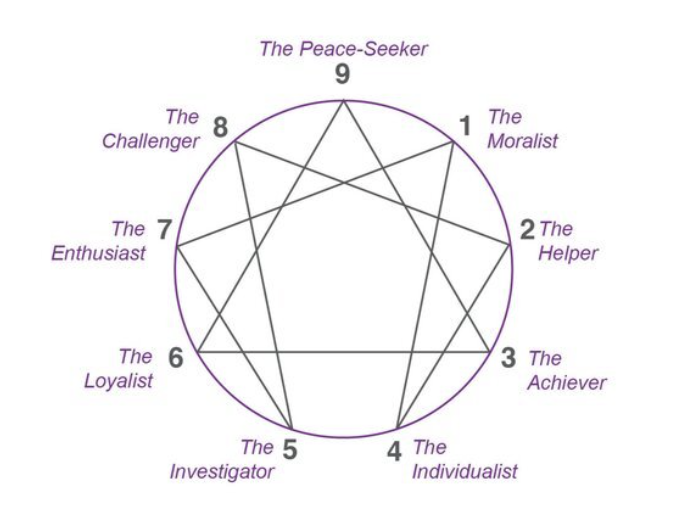
Hari Prasada: Yeah, exactly. Why is it called the Ngram? It's called the Enneagram because it comes from the Greek, the root EIA means nine and gram is a figure. So it's a nine pointed figure, and the symbol is quite popular where you see nine different points with a circle and connections between them, which represent another dimension of the Enneagram that we will not talk about in this series.
But hopefully in the future we'll have ample opportunity and so. It's these nine different personalities that make up the basis of a framework.
Rasanath: Thank you. So, uh, the word enya is nine in Greek, and so it describes those nine different, very distinct personalities. I remember you speaking very passionately about your introduction to the Enneagram the very first time.
You were just starting to come to the monastery, and I think I had read one book on the Enneagram before that and had become fascinated with it, and as we shouldn't be doing, try to apply it to other people instead of really apply it to myself first. So can you talk a little more about how you were introduced to the Enneagram and why you found it so compelling?
Hari Prasada: If my memory is accurate, it was when I had decided to become a monk, actually. And I had this, uh, wonderful mentor who was very well read and had gotten pretty deep into, uh, a book on the Enneagram by Richard Rohr called Discovering the Enneagram, and he. Said to me, I was going to him for counsel through my struggles of material attachments, trying to understand myself better and to really become my best and to grow and to become less selfish, more of a, uh, a free person.
Who just really lovingly serves others rather than so self-centered and struggling all the time as we tend to in this world, and I certainly do. So at that time, he understood that more of the knowledge about my unique personality would be really beneficial. So he pointed me to this book that he was reading, Richard Rohrs, discovering the Enneagram, and he had a sense of my type already, and he happened to be right many times we're not right when we have a sense of another person's type, which we'll talk about when we come to typing and also talk about Mistyping.
But, uh, he was very, uh, sharp and he understood what my type was, and he let me come to discover that. Indeed, I am this type. And so when I read the chapter on my type from that book, I just broke down in tears. I was so devastated, and the reason I was devastated was because it felt like somebody had just exposed all of the deepest, darkest secrets that I was keeping really tightly to the vest.
Not even consciously. I wasn't even aware of it, what to speak of, like seeing it categorized, organized, systematized in a way that made sense. One of the, the things that we find when we do these workshops on the Enneagram and do work with the Enneagram amongst individuals is people are like, oh my God, my own mind suddenly makes sense.
I thought it was just crazy. I, I didn't know that there's like a rhyme and reason to everything. And it really makes sense, right? I'm not just crazy. It might be crazy making, but I'm not just crazy. Yeah. It's like there's a real depth. To why I do what I do. And it is so profound when you get in touch with that.
It's also so painful because I felt exposed when I discovered it. And that is the understanding that we need to have. We'll talk again more about that in other episodes, but Richard Rohr would say when you've discovered your type, even though all types are equal and they are, all types are equal, no type is better than any other critical foundation.
You'll still feel like your type is the worst because it's like, oh my God, this is so embarrassing. This is so embarrassing. I can't believe I'm just seeing it all laid bare like that, and I never knew that this is everything that I'm up to.
Rasanath: I had a very similar experience when I rightly identified my type.
As I told you earlier, that when I first heard about the Enneagram, I was more excited about applying it for other people that I had wrongly diagnosed my own type, and I was very happy with my type.
Hari Prasada: Yeah, that's the sign right there. That's the sign. When you're very happy with your type watch out. That's very likely not your type, almost certainly not your type.
Rasanath: And then a few years later, the painstakingly becoming aware of, uh, the illusion that I had lived in. And my first reaction was, oh, I'm never gonna go back to reading this again. 'cause it was just very confronting. And at the same time, there is this experience of, you know, the truth does set you free undeniably.
And so when I did come to peace with what my type is, I actually discovered that there is a path to freedom from the traps that I experienced. And I think just in seeing the path forward was freeing in of itself, and the Enneagram has been absolutely invaluable in showing that. You can't
Hari Prasada: get free from what you don't see, right?
It's not, you can't get free from what you don't see. If you're not seeing it, if it's more convenient to not see things, that means you're being run by them. So, and, and that is the easy way out that we all take, regardless of our type, is I would rather not see everything but the Enneagram. Teaches a different approach if we embrace it in the right spirit and our, our own monastic journey and our spiritual practices teach a different approach that aligns so perfectly.
And what we find also in our work at Up Build is that everything ties to self-acceptance. Why I'm not feeling enough, why my ego is hounding me and harassing me, and I'm trying to prove, and I'm always striving and never feeling quite secure enough, never feeling enough, period, is because I can't accept myself.
I can't accept my real self. And it starts with accepting where I'm at, at a distance from my real self with my ego covering me. It has to start with accepting where I'm at and. Who I've become in this life and self-acceptance again, is at the heart of all of our struggle. Mm-hmm. And when we make progress in that direction to really understand and empathize with ourselves, we can offer that to others.
Our relationships improve. Our growth trajectory is so powerful and the impact we have on other people, as well as on our own fulfillment is just monumental. So self-acceptance cannot be avoided, and therefore seeing things about ourselves cannot be avoided. Right? We have to walk through it, and the Enneagram is an incredible support.
It's an incredible support and impetus for that journey.
Rasanath: And the natural byproduct of, uh, that kind of awareness is what we bring to the outside world, to our relationships, to our decision making. It now begins to come from a place where I am be, I'm starting to accept my myself and my trappings, and when I'm aware and I can bring the humility.
Of that discovery into my relationships, uh, relationships start to naturally get better because we have chosen to take responsibility. And that's what the Enneagram I felt really starts to do is teaches you, uh, what you need to take responsibility for, which can be confronting and at the same time it can be so inspiring when we do take on that mission of.
Responsibility for our own lives. I have seen in my own time, um, working with the Enneagram within the monastery, outside of the monastery in our work at up build, uh, the Enneagram being. Misapplied in different ways. Sometimes the Enneagram is like, oh, this really nice, cute tool for, for personality type.
Uh, it's a, it's an interesting, it's fun. It's fun. It's fun, it's fun and it
Hari Prasada: is fun in a way. But it also shows us a lot of things that are really quite serious.
Rasanath: Right. So what are the common, I would say, misconceptions and misapplications of the Enneagram that you have come across, and can you provide me and our audience.
What would be the right way to orient towards the Enneagram?
Hari Prasada: Yeah, it's just as we were talking that, uh, I take it on a surface level. Where it's just fun with personalities. Hey, what's your type? I'm this type, what's your type? What? And, and I get into tests, you know, Enneagram tests, everybody wants to take a test.
Oh, this is my personality. I get to answer all these questions and then it spits back an answer. And now I know who I am and magically the test told me who I am. Uh, that does not work. Unfortunately. The approach has to be one of seeking. It has to be really, I want to understand. I'm seeking, I have to become a seeker, seeker of the real self and again, of where I'm at so that I can bridge the gap between the two.
That is highly uncommon in life and it is certainly highly uncommon with the Enneagram. And the more the Enneagram becomes a popular tool, the more it is, uh, a tool of the masses naturally with a consciousness around like, what's the easy, fun, cool thing here? And it's used in organizations in the same way.
There's a lot of mistyping, which, uh, we won't spend time on in this episode, but which we will talk about. Soon. So it behooves us to approach with a, a gravity. Mm-hmm. That, yes, we want to have fun. We're, we're not saying we don't wanna have fun, but what is fun? Is it just like frivolous? Is it just something, ain't it cool?
And like, what are you, what are you, here's what the test told me, and like, now how do we react as a team? Or how do we react in relationship? It requires so much more depth of understanding and so much more of a, uh, a gravity that I'm ready to discover things about myself and I'm ready to really be curious about other people.
Mm-hmm. And compassionate, because everybody's suffering. And it's not convenient for me to see their suffering because I would rather be stuck in my story of why people are wrong and why my life is being negatively affected. And there may be truth to all of that, but it's not so helpful to be stuck in that story.
Right? Regardless of how true it is, we're not. It's really helpful when you understand what's actually going on and you have that spirit of service wanting to understand and be compassionate and serve. And that starts with me. I have to wanna understand myself and really accept myself as we were saying, and go from that place.
So. Enneagram tests might give clues to help us, but more often than not, we find they mislead. And no matter how many times we warn that, you know, our teachers, Don and Russ, who have created the best Enneagram test, the only one that's scientifically validated, and they talk about how this is just providing clues and it's giving you the top three possibilities and.
Still people become attached to their type and it also robs us of the process of self-discovery, right? We also don't take into account how much we are biased in our answers, so we really want to try to see ourselves as we are fearlessly. To offer that spirit to other people. I want to see you and to understand you, and to be there for you and orient towards you the best that I can.
That's it. That's the key, and that means seeing my ego and owning it, taking responsibility for it, as you said, and trying to get it out of the way. Peel off the layers to get to who I really am.
Rasanath: Right? That's it. Thank you. That is a, a very good orientation for individuals who want to understand the Enneagram.
And we have also come across in our work skepticism around the Enneagram framework itself. Like, well, is it putting people in boxes? Is something that we commonly come across. How would you respond to that?
Hari Prasada: I would just quote, uh, Don and Russ that. The Enneagram is not putting you into a box. The Enneagram is showing you the box you're already in.
Um, and uh, and it's giving you a chance to get out. If you don't see the box you're in, if you don't see that you're in a box in the first place, 'cause everything is normal and comfortable, then you will never know what is beyond the box.
Rasanath: Yeah, it's true. And then if we don't accept the fact that we are not in a box.
Then, well, we don't need the Enneagram because it seems you're free to begin with. So it doesn't need,
Hari Prasada: if we don't accept that we are in a box. Yeah, yeah. We don't, yeah, yeah, yeah. Then we don't need the Enneagram 'cause we're free. Yeah. Yeah. We
Rasanath: are free Anyway. So there is a way in which, as you said earlier, you have to be seeking, and seeking requires, uh, some degree of humility, uh, to approach this from a place of humility.
This is a way for me to discover my deeper self. And, and that's when I think the Enneagram actually gives its greatest benefit, uh, new approach from that place.
Hari Prasada: Yeah. Then it's so powerful and, and it's really like there's, it, it becomes addictive in, in the best sense that I want to know more, I wanna understand more, and I want to really grasp.
The infinite universe of human consciousness that the Enneagram is showing us so much of.
Rasanath: Excellent. So last few minutes, what will our audience get from the series?
Hari Prasada: We're going to talk about the levels of consciousness, which is the foundation of the whole framework in which gives it its purpose that we want to climb from lower levels of awareness, lower levels of being and of health.
To higher levels of awareness, higher levels of being and health. Ultimately, to get free from the ego altogether, to be liberated from those shackles to be who I really am. So the levels of consciousness is the most critical cornerstone for everything, and it's how will also look at the nine types on the Enneagram.
But before we go into the nine types, we'll talk about how to identify your type and wing. That of others as well so that we can understand them. Once again, we'll also talk about Mistyping, as I mentioned, and we'll conclude with a way to really anchor these teachings, these learnings, and to carry them with us the best that we can.
Rasanath: I'm super excited for the series. This is essentially converting so much of the work that we have done. Trying to condense it and put it in a way that our audience can really understand and appreciate and begin to embark on this journey of self-discovery through the Enneagram. And, uh, my hope, my sincere hope is that in this series will be exciting for everybody who's going to be listening to it.
I'm personally excited to be doing this with you. Um, likewise, big time. This together, uh, sitting, sitting in Martha's Vineyard, uh, at a very difficult. And a painful juncture in our own spiritual journeys. And the, the birthing of the workshops and this Enneagram work came through that. And also, uh, through the blessings of our teachers, including Risa, who very freely asked us to take this outside.
So stay tuned. More is coming your way Thank you very much. Thank you for episode.
Hari Prasada: Thank you so much. Thank you.
Episode Transcript
Continue Exploring the Enneagram
Browse all Enneagram podcast episodes
Understand the Enneagram framework — clear breakdowns of the Types and how the system works
Join our live Enneagram community, Enneagram Library Live, hosted by the Upbuild team.
Take the two-day Enneagram 101 workshop