
The Upbuild Enneagram Library
The Inner Critic: The Mouthpiece of the Ego
Subscribe on: Apple Podcasts, Spotify, YouTube, or wherever you get your podcasts

Episode Description
We live in a constant negotiation with an Inner Critic that tells us we are not enough. In this episode, Vipin, Hari Prasada, and Rasanath shed light on the Inner Critic as the mouthpiece of the ego. Using the Enneagram, they show how this voice operates differently across the Types and how it’s rooted in our Basic Fear, continuously pushing us to become someone we think we should be.
They introduce the idea of the Inner Critic game, where we are perpetually earning and losing points based on how well we meet our ego’s expectations. From perfectionism to performance-driven validation, this system quietly shapes our thoughts, behaviors, relationships, and culture, forever creating a heightening tension, and at best, the sense of never quite arriving. This episode is not about silencing the Inner Critic. It’s about understanding it, seeing the patterns more clearly, and beginning to work with it by greater awareness, compassion, and newfound freedom.
Podcast Hosts: Michael, Hari Prasada Das, and Rasanath Das
Listen to this episode on Apple, Spotify, or your preferred podcast platform
Highlights
[03:00] The Inner Critic in the context of the Enneagram
[04:40] The connection between the Inner Critic, Basic Fear and Basic Desire
[08:30] The mechanism of the plus-minus game
[12:40] The example of high achievers experiencing emptiness after success
[15:00] The Type 1 Inner Critic
[23:20] The role of existential fear
[27:00] Understanding imposter syndrome
[32:30] Humility as a starting point for change
[39:10] Building a spiritually aligned relationship with the Inner Critic
Quotes
"The ego…creates suffering, and if we develop the desire to be free from suffering, then we have to transcend the ego." -Rasanath
"In order to get to the soul, we have to see how we're crushing the soul." -Hari Prasada
"This work isn't about silencing the Inner Critic. It's about relating to it differently, with more awareness, more compassion, and therefore more choice." -Vipin

Episode Transcript
-
This is an automated transcript and may contain minor errors.
Vipin: Hi everyone. This is Vipin and I'd like to welcome you to another episode of the Upbuild Enneagram Library. I'm here with my partners, Hari Prasada, and Rasanath. Hey guys.
Hari Prasada: Hello.
Vipin: Great to be with you. Today we're talking about a voice that most of us spend a lifetime negotiating with the inner critic, the voice that tells us we're not quite enough, that something needs fixing, or that we should already be further along.
Sometimes it motivates us more often, it exhausts us, and that inner voice that evaluates judges second guesses or pushes us to do better or be better, that is the voice that we're talking about. For some of us, it's loud and relentless, and for others it's quieter, but always present. Rather than seeing the inner critic as something to eliminate or silence, we wanna understand it, why it exists, what role it plays in our personality, and how we can work with it in the context of the Enneagram.
So to start Hari and Rasanath, how do we define the inner critic?
Hari Prasada: What we realized through our years of work, it was something that dawned on us as we were actually putting more into our working with your inner critic workshop. That is an Enneagram workshop, but that goes deep into the psychology of our human condition.
We found that. The inner critic is really simply the mouthpiece of the ego. It is just that which gives a voice to our ego and at upbuild, we define the ego as the identity of who we think we should be rather than who we are. All the projections, all the images, the ideas about ourselves that we want validated, that we want to protect and defend and proclaim, and the inner critic is just that voice which tells us how to do that, when to do that, and never stops.
It is something which is audible, but also something which, as Vipin said, is ever present. Whether we can hear it or not, urging us to fulfill our ego identity. You can do it. You can do it, you can do it, but you're not there yet. You're not there yet. You're not there yet, so you better work harder.
Vipin: And why are we talking about the inner critic in the context of the Enneagram?
Hari Prasada: The connection to the Enneagram is that it is the inner pusher for each type and it carries a unique voice. There's something universal, but there's also something unique for each of the types. So depending on how our ego structure has been formed, which has a lot to do with our type, there are other factors, but the type is definitely a, a strong driver.
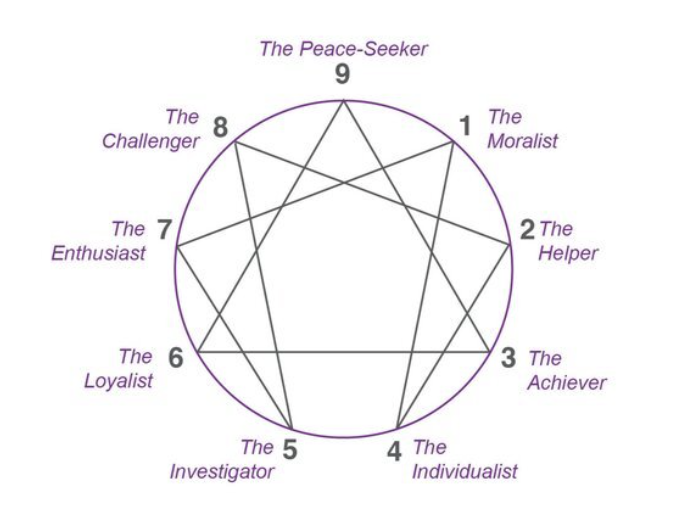
The inner critic will carry a certain voice and particularly. It will give us what it is that we're trying to achieve as our ego. So the 1, 2, 3, 4, 5, 6, and so on, all the types, they're all trying to achieve something to become something that they're not. And the inner critic has completely merged with that, right?
It's, I mean, it's the ego itself. So, and it wants us to merge with it, but we never can because it's not us. So how it relates to the Enneagram is it gives us clues and it gives us something to look out for in terms of how specifically we are being moved, where, why, what's it sound like? What's it doing to us?
And that will give us a handle on how to actually work with it, as is the title of our workshop.
Rasanath: We also know from our, understanding of the Enneagram that every type has what we call the basic desire and basic fear. And the inner critic is essentially reminding us of our basic desire constantly, and is making sure that our basic fear doesn't come true,
Vipin: that we avoid it at all costs
Rasanath: that we avoid it at all costs.
Hari Prasada: The problem is while we're under the spell of the inner critic, thinking that yes, I will achieve my basic desire finally, and my basic fear will be squashed finally. It never works, ever. We are not our egos, so how can it work when we're being driven to become something that we are not? No matter how much we think we are that and we convince ourselves and we give ourselves pep talks based on the inner critic.
You are this. You can be this. You can do this. Dream big, you can do anything you want. You are that. It doesn't work because we are fundamentally not that we are something else. We are the self. We are not our egos.
Vipin: In that context, even the basic desire and the basic fear are functions of those egos. So even pursuing those doesn't make any sense from the self standpoint.
Hari Prasada: That's it.
Rasanath: The ego mostly creates suffering, and if we develop the desire to be free from suffering, then we have to transcend ego. There is just no other way. Now, what the ego does convince us of is I'm also the one who will protect you from suffering. That's the identification in the illusion that the ego creates.
I will protect you from suffering. There are only a few requirements, and as long as you fulfill those requirements, you'll be more than fine.
Hari Prasada: The inner critic is pleading with us. Just listen to me, then you'll be all right then you'll be great. And we take it and we're in its pocket.
Vipin: Let's connect the inner critic with the Enneagram more tightly here. And I would love to hear, how does the inner critic tend to sound or operate differently across the nine types in the Enneagram?
Hari Prasada: At the Enneagram Institute, Don Risso and Russ Hudson would. Create a chart that shows the inner workings of each of the nine types based on the inner critics urging.
We are not going to go into all of the details of these charts, today. But based on that understanding, we can see the very specialized features of our particular types inner critic.
For example, if I am a type five, my inner critic is telling me, you must be somebody who is so knowledgeable. You can feel encyclopedic, the basic desire as we coin it. You must be so knowledgeable that you feel encyclopedic. So then I'm driven. I have to get knowledge, have to get knowledge, have to get knowledge, and then that also means I have to be able to spit it out so that I can prove to myself, I'm knowledgeable, I'm knowledgeable, I'm encyclopedic.
I can feel it. And there are different ways in which the inner critic presses us to do that.
Rasanath: the inner critic, it invites us to play a game and Russ would call it the inner critic game. And it's very much like when you see the three Card Monty Game in the streets of New York.
Now the idea is that based on the basic desire and the basic fear, the inner critic will award you points. So if you do something that makes you experience the fulfillment of the basic desire, the inner critic will say, oh, here you go, plus five. And then when you are living a moment where you are not experiencing the fulfillment of your basic desire, the inner critic will say, minus five.
So now it's this game where I'm just getting points for realizing and living my desire or not realizing in essentially the opposite, experiencing the fear. All the nine types in their own unique ways experience this mechanism Pluses and minuses. Pluses and minuses.
Now, the challenge with this kind of game, as we have all experienced, it is. When the pluses come, it's not that I say, okay, I've gotten the pluses. Now I can just relax. When the pluses come, I feel like I want to get more pluses. Oh, I got this. Maybe I can get even more. Right? So when the minuses come, then I'm like, oh my God, I lost, and now I have to get the pluses again.
So the inner critic knows us. It's like what happens when you go to a casino, when you lose, you play. When you win, you play. So this just keeps us completely trapped in the game, and it just becomes impossible to quit because when I quit, it's akin to not having an identity anymore.
Vipin: This game seems particularly suited to the Type Three's ego structure, I mean to prey on the type Three's ego structure.
But you're saying this is the game that every single type is subject to?
Rasanath: Yes, because I feel terrible when I get awarded. The minuses not the flavor, and when I get it is different for every type.
but ultimately we are all playing the plus minus game.
So when we go back to the sense of identity, one thing that you want to do is sustain that sense of identity at a certain level. Now we all know, and deep down that's what we are so deathly afraid of Given the innumerable uncertainties that we have in this world, that identity is actually not sustainable.
So for example, in the case of type three, I will get the accolades and it feels very good when I get the accolades, when I gives this outstanding speech, and like everybody is standing right, and then I walk home feeling like, oh, this is so good. But the next morning when I wake up, I have to sustain what happened yesterday because it's lost its shine.
Now for me to feel as successful, I have to keep producing. Right, and the next morning again, the inner critic is saying, all right, let's see if you can do that again today.
Vipin: Right, Ana, I'm just reminded of a very dear client of ours, and what happens for those who actually feel like they can sustain that identity, who feel like, well, I've accumulated enough points on the scoreboard to be able to point to that.
Even if I have a slight dip, I always look at the scoreboard and know that I've got many, many plus fives, so I'm okay.
Rasanath: The fact that I need to point to that scoreboard every time is proving to the other side that, Hey, you know, is this enough?
Hari Prasada: But I don't know that I'm doing it. That's the problem. I don't know that I'm pointing to the scoreboard, so if you ask me, I'm like, I don't need to point to the scoreboard.
I'm good.
Vipin: Yes. And then there is also, I don't stop, if I'm being really honest, if I'm being really honest, that's a way for me to not feel the shame of not producing anymore.
Hari Prasada: It's hard to be that honest. This is what we have to develop that honesty.
Rasanath: If we really look with a very fine tooth comb, I am still making the attempts to make myself feel productive. I'm still continuing to do things, but I'm concerned that I may never reach that same level of external success, and so I have to live off of the memory.
Interestingly, the New York Times produced this incredible article, I think it was last year, where several very successful sports people from across different sports spoke about what the experience was after winning the biggest championship and they all confessed to experiencing depression post. And they said that it really woke them up to asking the bigger questions around, well, what is the meaning of my life?
That is the honesty that is required? And most of them then turned to some form of spirituality. One of the interviews that was published was Michael Phelps, who as far as we know right now currently is the greatest swimmer that we've ever seen. And he very characteristically, very honestly speaks about his winning of 12, breaking Spitzers record and winning 12 Olympic goals, I think it was.
And then still like post experiencing a real down. What else to then pursue after that. And with the recognition, especially in this field, that my body will never be the same. So to perform at that level, to sustain performance on that level, my body is never going to be the same. So the recognition that, well, this is it, it's pretty stark.
Hari Prasada: And that comes for all of us in some unconscious way that we're aware, even we don't think about it. But we're aware this body has a very short shelf life. Very, very, very short shelf life. And compared to the limitless nature of our desires, the amount of desires that it can fulfill within this life is nothing.
And then we have to convince ourselves, but it's enough and we settle
Rasanath: Well, I had a great life.
Hari Prasada: I lived a life, I did it.
Rasanath: Even when it's expressed, it's a constellation. Huh. It's very rare to actually experience the fullness of gratitude.
Vipin: Thank you. So I'd love to hear about one additional types inner critic, just to see how it sounds or operates differently
Rasanath: One example, a very visceral way of experiencing the inner critic in all of us. Is the type one
So if you think about the primary inner critic message it's based on the basic desire and basic fear. So the inner critic is essentially saying you're good and or okay. If that's the condition that it creates for all the nine types,
Vipin: you, this person are good, meaning me, I am good, or okay.
If,
Rasanath: yes, if right. Dot, dot, dot or fill in the blank. And for the one, you are good or okay. If you are uncorrupted, and as we know for the type one, once there are, my standards are very high. By definition, they're perfectionists. That is a very high standard, an extremely high standard. So when I reach that standard, and this is the example that's typically given, I love to keep my place clean for someone that is the standard of being good.
I want to keep it spotless. And so because my standards are high, it takes a lot of energy and time to do that. And when I do that, I get a plus. But it comes at the cost. Something else being neglected. So somehow in some other part of my life, I am not good. It shows up that way because I spent so much time maintaining a certain standard in one area of my life.
Now, for the one, the way it registers is the minuses, then I get a minus. It is, it registers pretty loud. It's true for all the types, but the way it comes across for the one is for every plus that I get, when I get a minus, it actually equates to five minuses because of how high my standards are. So it's not just that I didn't reach my standards, it also shows how badly I neglected it.
So it's like a fail grade. Now what happens is the way I compensate for it is now I have to get a plus. And remember, the standard is very high. So the energy expansion that I have to do in order to reclaim my plus is significantly high. Which then also increases the chances of getting several minuses in another area of life.
Vipin: You're on a, yeah, a treadmill there,
Rasanath: right? The way the equation is set up,
Hari Prasada: doomed, it's rigged.
Rasanath: Now let's actually relate it to the inner despair of the one. So the one of the things that we experience when we talk about the one as they go down, the levels of consciousness is resentment and hopelessness.
The anger at my own self for not being a good person. When you think about that and you see what's happening in the inner world of the one where I'm swimming in minuses and it doesn't take much to get one, it takes a lot to get a plus. It doesn't take much to get a minus. The suffering is very acute.
And then when it gets too much, this is what leaks out into the world. So for every type, this is what I do, is when I am swimming in minuses, what can I give the world? I can give them pluses. Because what my inner world is surrounded by is minuses.
So now when it leaks out, it's basically it comes out in the form of judgment. I am now expending the minuses for other people. You are bad, you are wrong, you are incorrect.
Hari Prasada: What's so important to understand is that this is not conscious. I can't emphasize this enough. I know ones who would say, yeah, I'm fine, everything's fine.
I know I'm a good person. That's not matching the inner reality. That's an approximation for our egos to be able to live with ourselves, but it's a faulty approximation and other people experience the faultiness or even falsity of it. Other people experience unbeknownst to me or bewildering to me. This person is really harsh.
I don't feel good about myself when I'm in this person's presence. And the one is like, why not? I can give you so many examples of this from really good souls who are ones, so what to speak of those who are not so kindhearted, not so on the path of goodness.
Vipin: Thank you both for that.
The one's inner critic, as you've shared, sounds more extreme than most types inner critics. So I'm wondering no matter what type we are, what can we learn from how you describe the one's inner critic as the poster child for the inner critic?
Rasanath: So when you see the one, the experience of the critic is harsh judgment.
as the one goes down, the levels of consciousness, the experience of being around a one is you feel judged all the time. All the time. And what you actually also experience is to reach the standard of the one is a very hard task
Vipin: and that's what it is to deal with our inner critic.
Rasanath: That is exactly what it is to deal. You feel judged what the inner critic is saying and this is the mechanism of the inner critic, right? It's the let me shame you sufficiently before anybody else outside does it, because that way you'll be protected. Let me take on the task of what you will experience outside if you don't live up to your basic desire, and I will very generously do it for you.
I shame you first so that you don't have to be shamed by this. We are so identified with it. That's our boss. That's what we are essentially run by.
Hari Prasada: It's also there's a compensation happening. When I externalize these minuses, I'm trying to prop myself up. See, I'm good enough, I'm good enough.
See, this person is less good than me. So let me point that out to show my superiority. But this is all unconscious. Again, I can't emphasize this enough. If it were conscious, we would be able to do something about it, or it would just be so painful that nobody would interact with each other, right? This is happening on a subtle level that we have to get a hold of because it is silently ruining our lives.
Why is it ruining our lives? Because it's making us a part of a false system that doesn't fulfill any of us.
Rasanath: So what Har is just explaining is the izing. And that's what happens when others have more minuses than I do. So the mechanism of the inner critic reduces to, at a certain point from a genuine absolute aspiration to a pathetic relative standard where as long as others have more minuses than I do, I can take it back to the inner critic and say, now, do you think that I'm good or, okay, but how can we maintain that?
It's an unsustainable thing.
Hari Prasada: What happens is also, we'll experience this more in some relationships than in others, and we'll use the relationships where we don't experience the inner critic dynamic as intensely as proof that see, I am good enough and these other people are wrong, and that is very, very dangerous.
So we have certain relationships where the rub can be felt, and then we externalize that further. We say it's their fault. This is how we preserve our egos. We all walk around this world doing that until we stop doing it, until we work on ourselves and stop doing it. And for the one that's actually not more extreme, it's just more central.
As Don and Russ would put it, the centerpiece of their lives is so much the inner critic. It's so on the nose that we can speak about it in these terms, but really it's just showing us, the one is just showing us how the inner critic is in the driver's seat for all of us.
Vipin: So before we talk about what a different relationship with the inner critic could look like, just want to explore a couple more things.
When you think about. When the inner critic becomes most activated, it seems like that would happen when our basic fear is activated. Is that a correct understanding
Hari Prasada: Yeah, so the inner critic is always active when it becomes most activated is. In connection with the basic fear, as you've said. But the thing is, the basic fear is always there. It's existential. It is not situational. There are other fears that come in the hierarchy of our egos fears, and we've spoken about at least two of these when we talked about the transitional fears, shock point, fear and red flag fear as more prominent.
But Don and Russ point out nine different fears at nine different levels of consciousness. You know, this fear is what we're made of, and they're all emanating from the source of our particular egos fear, which is the basic fear, and that is existential, that is constant. So the inner critic is always sensing that fear and operating off of that fear, trying to get us to operate off that fear.
So we're always moved by the inner critic from fear. When it gets most activated is when something directly tells me. Ooh. You see your basic fear is coming true.
Vipin: And then how does it reinforce the ego structure?
Hari Prasada: So if we take the example of a type three, the basic fear is being worthless, and my inner critic is telling me, you better have worth, buddy.
You better have worth if you don't have worth. You know what that means? Worthless. Now, I don't ever hear the voice of that, which is the problem if I could train myself to hear, to listen for that voice. We have another podcast about finding the bait of the inner critic. We talk about listening for that voice and making it more audible and clear, rather than just letting it run us on autopilot silently.
So if we could hear this voice that. You are worthless unless you perform, you produce, you contribute, you make something of yourself. If we could hear that, we would be able to change it. We can speak something more about that after. But for the type three, this is what it's all about. I'm trying to outrun my sense of worthlessness and when somebody claps for another person, it can be literal or it can be figurative.
But we'll give the obvious example of at a TED Talk and there's a series of TED speakers, right? And I give my talk and you hear a light clapping sound. Then the next person goes and it's a vigorous clapping sound full of the applauding emotion. And when the three sees that somebody else got the full applause and I got the kind of nice gesture, yes, we appreciate it.
Thank you. Nice work. I can't stand it. That immediately triggers talk about most activated. It triggers so intensely that basic fear. I'm like, what am I gonna do? How am I gonna come back? I'm now like catapulted into this. State of UN being, non-being, and I gotta become like the phoenix rising from the ashes.
I will make something of myself. I will come back, I will show you. Or if I don't have that vigor, I just become extremely depressed and people won't see me for some time until I can develop that vigor. Neither one is good, by the way.
Rasanath: The other thing too, when the inner critic becomes active, and again with the example of the type three, a lot of threes will as they become honest, talk about imposter syndrome.
And the interesting thing with people is, well, gimme a reason why you feel the imposter syndrome. It's like, I have done so many things in my life. I have achieved so many things in my life, and yet I feel like an imposter for the next thing.
Why is that? Is because the way the critic operates. Even when it's giving you the pluses, you know how when, yes, I'm giving you this, but don't think you did it because you are good. Right? There were so many people who are actually better than you. You were just lucky. But you know what?
Take this, it's okay. The reason why I brought this up is because the inner critic is always active. It's tone. It's different based on the circumstances, but it is always egging you.
Hari Prasada: And I think the problem is I just need to root out the imposter syndrome. And so the way that I will quote unquote work with my inner critic, which is not what we're talking about, is actually working with your inner critic, is I'll just give myself a pep talk.
I will convince my inner critic that I am so damn good. It'll have nothing left to say. And then, you know, I sign up for this self-help workshop where I'm like. Pounding my chest and I'm so amazing. You can't believe how amazing I am. Why? Because I said so damn it. And it's crazy. It's crazy. We're just trying to insert more of something false onto something that is already false in the first place and thinking that will do it.
And because we drown out everything else for some time, and the more we do it, the more we become convinced, well this is great. I just drowned out everything else. But what is that? How fulfilling is that? That's a adrenaline, but it has nothing to do with the heart or the soul of who we are. It's exactly going in the opposite direction.
So this is a trap the inner critic leads us to. And with the example I gave of the type three, anybody would feel devastated. By not getting the reaction that they wanted and then somebody else getting exactly the reaction that I would've wanted. You don't have to be a three to relate to that example.
For the three, this is like death. So then we immediately compensate because we don't wanna feel that death. We don't want to feel that. So it's like, all right, well I just need to go to a therapist. I need to go to a a workshop, or I need to go to a coach or to this person or that person who will give me the tools or really the inner critic conviction that I am okay anyway, no matter what happens.
I'm okay anyway because I'm just good enough. But what is it based on? It will never work unless it's based on something actual. That is where we have to go to the self.
Rasanath: One of the common things that I've also heard, and this also happens a lot, for example, in parenting. Is the sense that, well, if I didn't feel the inadequacy, I would never achieve big things.
Vipin: Yes. I've heard this many times
Rasanath: what happens, and this is very specifically tool for the type three. Somebody recently quoted an example of Coco Golf, I think when it was when she first won the uh, the US Open, and she spoke about how she converted her anger of failure into the successes actually attributing the drive.
Right?
Hari Prasada: Yeah. This is a known strategy. This is very normal. Yeah.
Rasanath: So there is a way in which now I actually become addicted to the negative. Now I think that the negative is actually an impetus for me, but it's negative fuel. You can't sustain life on negative fuel and for some time it'll work, which then gives me the illusion that, okay, I'm just gonna use all of it.
And then it actually leads to emotional burnout because it is so relentless. And the reason why, how I connected it to parenting is sometimes parents feel that is the strategy to get kids to drive ambition. And then what happens unwittingly, unknowingly, and for so many of us, this is true. As we grow up, we begin to see that the voice of the inner critic actually resembles the voice of somebody who was very close in our life, unwittingly the parent or whoever that person was, conflated with the already existing inner a critic voice.
And this then creates, I mean, we can have a full podcast on how pretty much the entire world is. Essentially any relationship is two inner critics interacting with each other.
Hari Prasada: And deep down, we know this is soul crushing. We know it, but we're not honest with ourselves. We don't want to go there to find out, because it feels like that would be more soul crushing.
It's not. Actually, in order to get to the soul, we have to see how we're crushing the soul.
Vipin: One thing that we've heard in our workshops is that some people say they used to have an inner critic, but I have solved that, or I've learned to fight it or suppress it or get rid of it even. So what typically happens when people try to fight, suppress, or get rid of the inner critic,
Rasanath: all those expressions are essentially the inner critic trying to tell you that you are beyond the inner critic.
Essentially, what's telling you is yourself realized. Take the pluses for being self-realized. You know,
Hari Prasada: I'm so awesome. I don't even have an inner critic. I know exactly what to do. Any problem that comes up, inner critic, minor stuff. I'm just that good. I'm so beyond. Mind you, someone who's self-realized never thinks like that.
Rasanath: No, no. This is akin to what we talk when we talk about humility. I'm just so humble. I'm so incredibly humble, really, like I wish you knew that more, but I'm just the humblest person I know. Now, we all know that, as you know, as people say, humble brag, right? That is not humility. It is really not. It's pretty much the same flavor.
So it's important for us to understand that transcending the voice of the inner critic has a very different experience, and it doesn't happen. It really doesn't happen without us learning how to work with it. The dissolution of the inner critic is a direct byproduct of the true self emerging, and before it dissolves itself, it'll create the utmost humility it does.
Why that is the case is because at a certain point, I realize how badly I'm in the grip of the inner critic, how through my effort. I can never really free myself from this. I need help. Right. And that submission, that humility alone becomes the starting point for us to even begin to work within a critic.
What to speak of transcending it. If we look at it, if we really look at it, what does working with inner critic or even eventually transcending the inner critic require? It's paradoxical. And the paradoxical nature is you can't defeat the inner critic. It can give you the illusion that you're defeating it.
It is so tricky. I remember when I used to watch Cartoon Network and it really struck me how powerful this was. I remember vi vividly, very vividly bugs money playing tennis and you know, you'd see how restless bugs money is, but the bugs money plays tennis bugs. Money is serving from one side. And then he runs across the net, hits the ball from the other side and he's, he's like both players.
And then he's also the commentator who's describing how both players are playing, how one player's playing bad, the other player are playing good. That is essentially what the inner critic has created it com. So the meta level on which we have to really understand and also not identify with that voice is anonymous.
It takes work.
Vipin: When you say the inner critic can't be defeated in that way, how does the inner critic respond? I mean, if I get plus fives for thinking I'm beyond the inner critic, then where do the minuses come in? I, I would think that that's a good thing. I'm getting pluses, so I should just stay in that zone.
Hari Prasada: I'm suppressing the minuses. I'm secretly suppressing them. They're there because deep down, I know this is not the real thing. This is not how it works. I don't deserve those pluses. They're not based on something.
Vipin: It's like fake grades, grade inflation.
Hari Prasada: Yeah, exactly. You can go and convince somebody that you're the best wrestler in the world.
You're the best wrestler in the world. You're the best wrestler in the world. Go out there and wrestle somebody. But eventually it's gonna be found out. You might get a lot of hype and you might be able to defeat somebody based on the false confidence, 'cause somebody else doesn't have that same hype. But eventually you're gonna be found out and the inner critic holds that.
Very insidiously as if you don't want to be found out, you better submit to me forever.
Rasanath: Now, typically, you'll see the minuses. A critic at that point in time come out in the presence of people who have genuinely transcended, because now suddenly you feel like I want to be one among them. I want be like them.
And in their presence, you will actually see, oh yeah, I don't feel any of these things. Just the way it's expressed. It's just externally exemplifying what is happening inside. I'm feeling so bad that I'm still a prisoner, that I have to, I'm essentially having a conversation with my inner critic, but now it's being projected outwards, right?
Like I am good. I am not this way that that's the inner, you know how sometimes our private conversations are somehow leaking out? That's what's going on.
Hari Prasada: Anyone further along is a threat to me. Anyone further along is a threat and my suppression doesn't work. It creates so much emptiness and so much squeeze, and I just have to wake up and call it out, and then it's all right there in front of me.
I'm not immediately, it takes time to unravel, but it's there. It's present. So that's really our appeal is, please, please, no more suppression. We're all suppressing in so many different ways, our inner critics and all the minuses, and we're trying to run on this wild goose chase after pluses that are totally meaningless.
And when the body dies, we don't take any of those pluses with us, no matter how much we've convinced ourselves. Well, it was a good life. What is that? We have a self, we are somebody, some curiosity, some honesty, some desire to be truly fulfilled as needed if we wanna uncover that. And that is the best thing there is.
So it's a really stark picture. On the one hand, you have something totally false and empty and crazy making, and on the other hand, you have something so beautiful, so heart melting, so perfectly inspiring. And it almost sounds mythical, too good to be true. But the more you actually move from the one extreme to the other, the more you see the truth of it, you experience the truth of it, and you can live that truth and offer it to others, which is the reason that Upfield exists.
Vipin: So let's finish on this most important question. What does that more mature, spiritually aligned relationship with the inner critic look like?
Hari Prasada: Be honest. Look introspect. See what's difficult. See what's so uncomfortable. See what is so threatening that, uh, I absolutely wanna shove under the rug forever, which means that I merge with my inner critic forever, and I'm, I'm the surrendered person to my ego, to my inner critic, which is the proxy for my ego.
That is a terrible situation. It is a dire situation, and we cannot wait even a single moment, more. It is required right now to change this. It is so imperative, it's so urgent, and it takes so much time, and we don't know how much time we have, so please be honest. See that this is happening. See that there is an alternative.
We have subscribed to something as if there is no alternative, or we look for alternatives within the same paradigm, which is talk about circular again, crazy making. So please, please be honest and then seek help. Be humble about it. Seek help. Don't be threatened by others who are further along, better to submit to them than to submit to the ego, the inner critic.
That's the way out of it. That's what we're trying to do and what we're trying to offer to others, and learn about what is the nature of the real self, and try to apply those teachings as we're trying to uproot the coverings to the true self.
Vipin: Thank you, Harry Pana. Any final words that you would share on this?
Rasanath: My hope is to do a podcast at some point in time on the topic of parsing the inner critic. Because at the core of it, the inner critic is actually conveying some kernel of truth, but it is so harsh and the message is so distorted, it's so toxic that we can't pass the truth from the nice. So a big part of the work, as we say, working with your inner critic is to actually understand how to, how to reach the kernel of truth and to be able to act on it, which then gives way the inner critic then over time starts to give way to what we call the inner guide.
Which is where we, uh, we experience the true spiritual benefit. The dynamic of that needs an entire hour to be able to explain.
Hari Prasada: Our working with your inner critic workshop is, is doing a lot of that, the parsing of what is real about the inner critic versus what is false. We've also written some reflections on the subject as well, but the main thing is not to buy into the false construct, to move toward the real thing with urgency.
And that already will help you to parse out things with that understanding and recognizing that according to my particular type, my inner critic is convincing me, it's keeping me under its spell. So look out for the hallmarks of my type and the way that the inner critic is leveraging that against me, saying it's for me, but really against me.
Vipin: So when we learn to recognize the inner critic, when we learn to be able to tune into the inner critic, we can actually gain a new kind of freedom. Because you've been saying Harry Persad many times in this conversation. A lot of this is unconscious, subconscious. So we have to first learn to be able to tune in to gain that freedom, and then we can hear the inner critic's voice without automatically believing it.
We can thank it for what it's trying to do. The kernels of truth that, that you both are speaking about without letting it run us, without letting it run the show. And then in that space, something more truthful has room to emerge. So this work isn't about silencing the inner critic, it's about relating to it differently, with more awareness, more compassion, and.
Therefore more choice. And over time, that shift allows us to move from living inside the ego's demands toward inhabiting the deeper self. That's always been there.
Hari Prasada: Yes, absolutely. Well said. And if you want to read more about this, there are a couple of reflections. How to Live with no regrets is one of them.
And I would specifically target, when will we stop beating ourselves up? That is a reflection that is very, very, very centered on this dynamic and what we can do.
Vipin: Thank you. Both of these reflections can be found on the Upbuild website. Thank you all for joining us for this episode of the Upbuild Enneagram Library.
We're grateful to be on this journey with you and I am. Especially grateful to be on this journey with the both of you. So thank you both so much for this conversation and I really hope it serves people in shifting their relationship with their inner critic.
Hari Prasada: Thank you so much.
Continue Exploring the Enneagram
Browse all Enneagram podcast episodes
Understand the Enneagram framework — clear breakdowns of the Types and how the system works
Join our live Enneagram community, Enneagram Library Live, hosted by the Upbuild team.
Take the two-day Enneagram 101 workshop